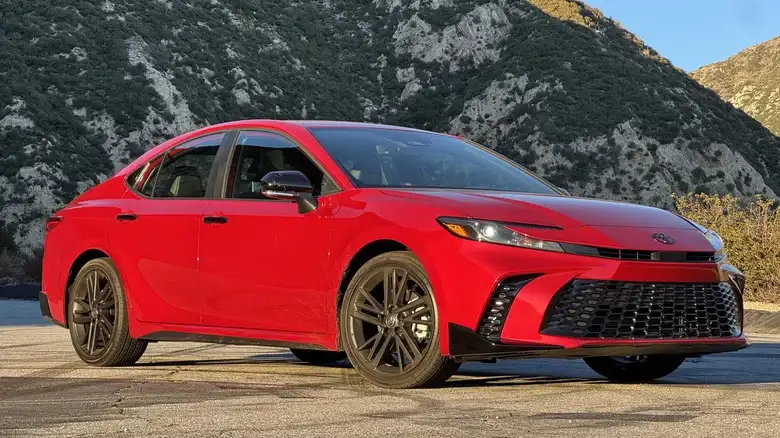
TOYOTA CAMRY Nightshade Edition: black trim, same heavyweight logic
The 2026 TOYOTA CAMRY Nightshade Edition is not a new Camry in the usual product-planner sense; it is a styling-led trim walk that tries to give America’s perennial sales leader a little more visual tension without touching the core formula. Toyota places it in the middle of the lineup at $33,795 including destination, while the test car’s sticker reached $35,878 with options such as the $735 12.3-inch screen, the $600 Convenience Package, and $475 Supersonic Red paint. That is exactly the kind of price discipline that keeps the Camry competitive against stronger-margined sedans and lower-volume crossovers.
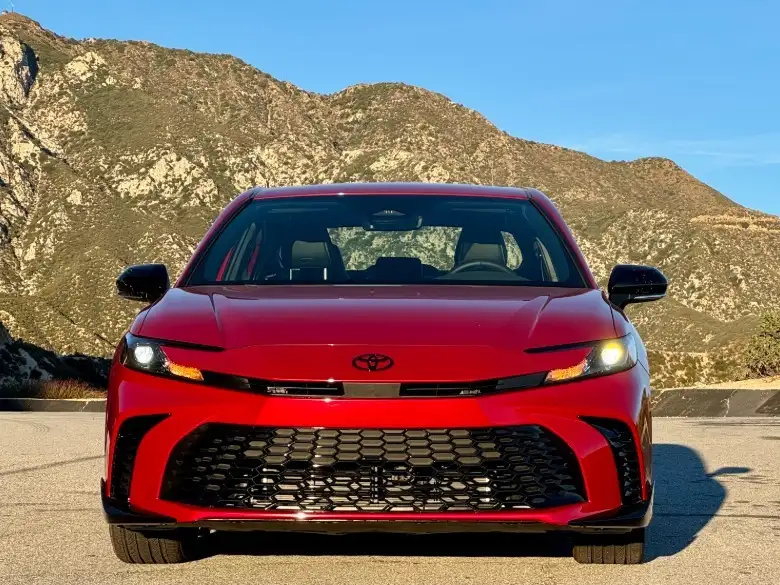
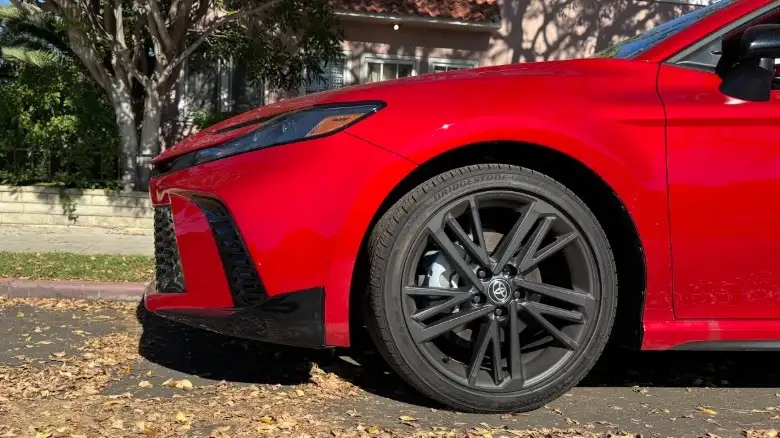
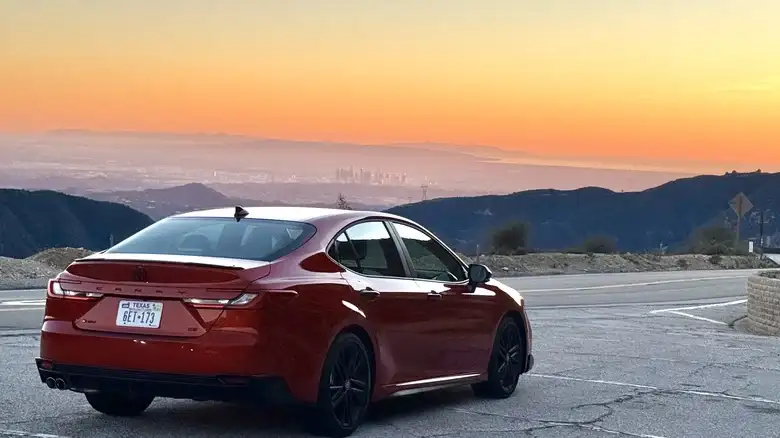
The Nightshade package works because it is specific rather than theatrical. Midnight Black Metallic treatment covers the grille, canards, mirror caps, antenna, rear diffuser, spoiler, and door handles, while the car rides on 19-inch satin black alloy wheels wrapped in 235/40 Bridgestone Turanza tires. Those details give the sedan a more coherent silhouette than a simple black-pack gimmick, especially against the red bodywork. If you want to see how other manufacturers are using image-led trim to stretch a mainstream platform, the comparison point is not a sports sedan but something like the Mercedes-Benz E-Class Night Edition, where presentation is being used to lift perceived value without reengineering the fundamentals.
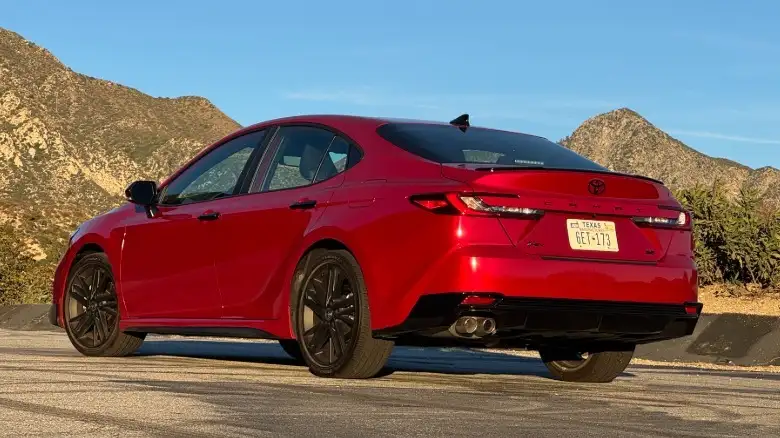
The hybrid-only Camry powertrain remains the real headline
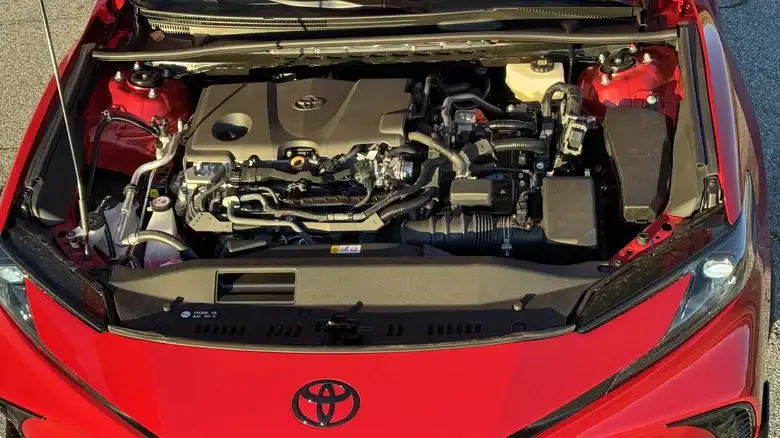
Toyota’s biggest strategic move for the ninth-generation Camry, launched for 2025, was the decision to make the sedan hybrid only. That means no gasoline-only version, no V6 option, and no market confusion about where the car sits in Toyota’s lineup. The powertrain combines a 2.5-liter naturally aspirated inline-four, a 134 hp front electric motor, and a 0.6-kWh lithium-ion battery for a total output of 225 hp in front-wheel-drive form, or 232 hp with all-wheel drive thanks to a rear 40 hp motor.
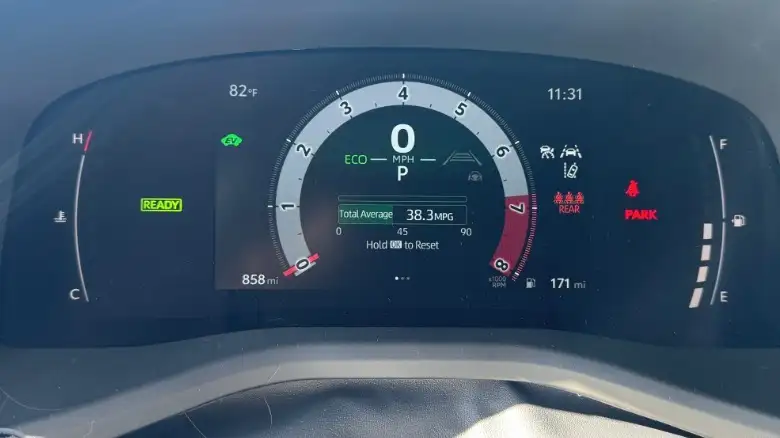
What makes the setup work is not headline power but the way it delivers torque and efficiency together. Toyota quotes as much as 5.0 L/100 km combined-equivalent efficiency in the most frugal front-drive LE configuration, which the source converts to 51 mpg combined, while AWD trims give up some economy for traction and a slightly higher output figure. In real use, the test car returned 38 mpg over a week that included hard driving and mountain roads, which is still an excellent result for a sedan that does 0-60 mph in around 7 seconds.
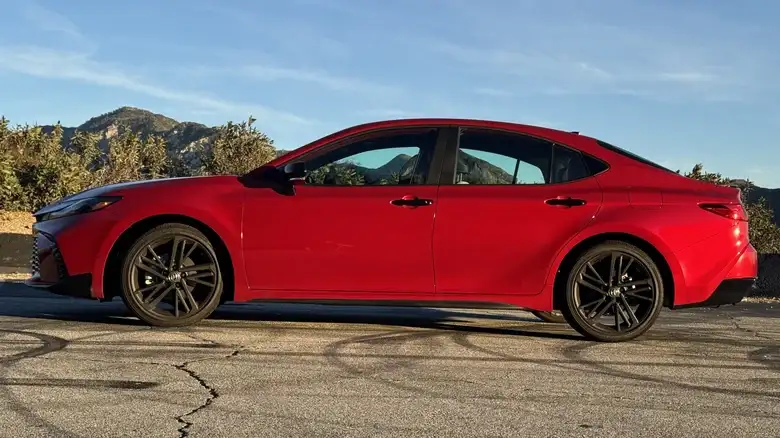
Why the Camry feels quick, even when it is not trying to be a sports sedan
On paper, the Camry’s numbers are modest beside true performance sedans, but the calibration is smart. Electric assist fills in low-speed torque, the eCVT keeps the engine in its efficiency band, and the transitions between acceleration, regen, and braking are nearly seamless. Toyota has spent decades refining hybrid control logic, and that maturity is obvious in traffic, where the Camry feels more eager than its 2.5-liter specification suggests.
The driving character, however, stops short of genuine playfulness. Turn-in is relatively brisk, and the chassis accepts a fast pace without falling apart, but the car does not invite overdriving in the way a keen chassis like the Alfa Romeo Giulia can. Lift-off rotation is limited, and if you want the nose to tuck, brake input is required to transfer weight. The likely culprit is not just tuning, but the combination of all-season-oriented Turanza rubber and a sedan engineered first for stability, quietness, and predictable ownership.
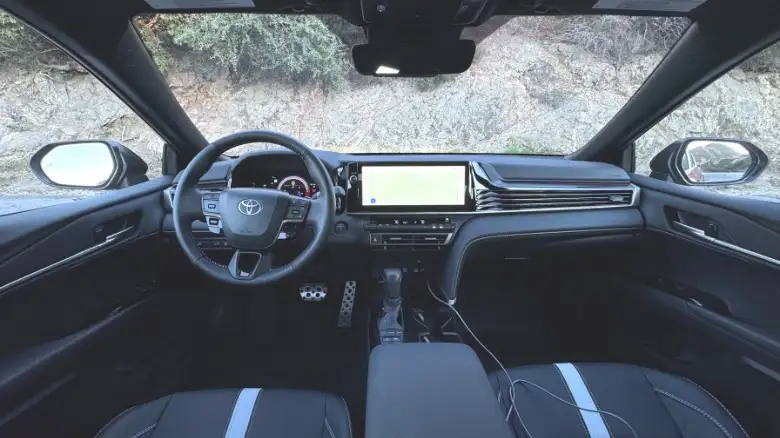
Cabin packaging, usability, and the limits of the Camry’s shape
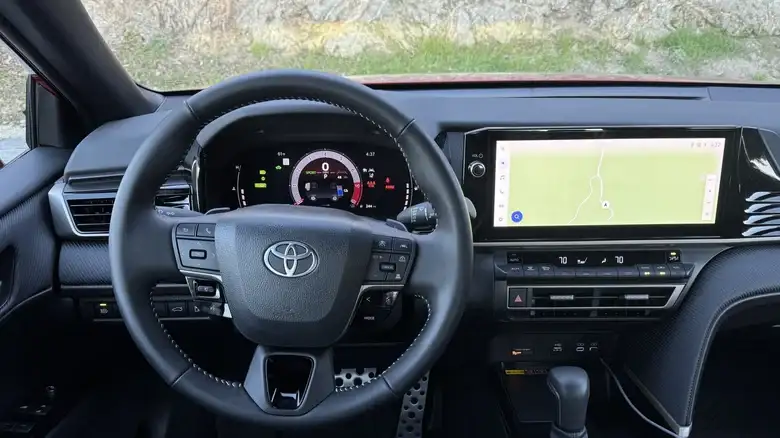
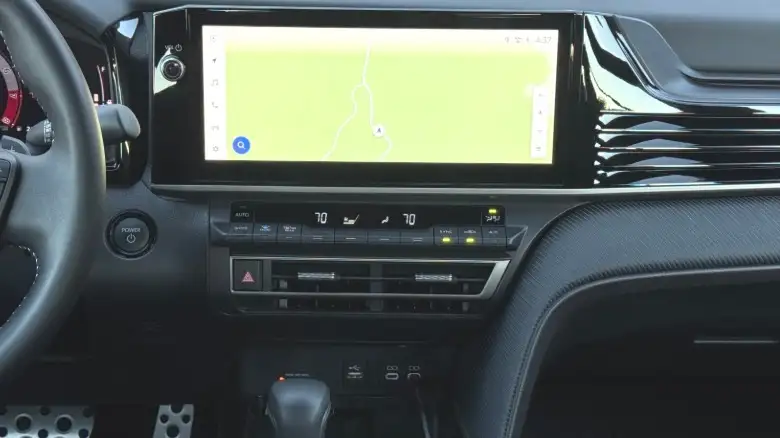
Toyota’s interior strategy is a study in controlled restraint. The Camry Nightshade I tested paired a 7-inch digital gauge cluster with the optional 12.3-inch touchscreen, and the basic layout still relies on physical controls for climate and major vehicle functions. That is the right answer for a car whose mission is to be used every day by a broad customer base rather than a niche tech audience.
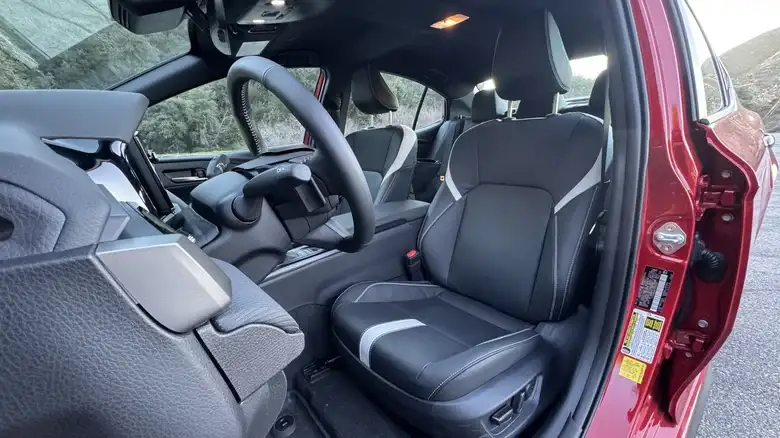
Wireless Apple CarPlay and Android Auto worked cleanly, the wireless charger made short commutes simpler, and the steering wheel controls were large enough to use by feel. The standard 6-speaker audio system was a pleasant surprise because it sounded richer than you would expect in a volume sedan at this price. The weak spot is space management: legroom is acceptable in both rows, elbow room is good, but headroom is compromised by the sloping roofline. At 6-foot-8, the tester found the front seat tighter than expected, and rear-seat passengers with long torsos will notice the roof’s taper as well.
[h2>The weak point Toyota still hasn’t solved
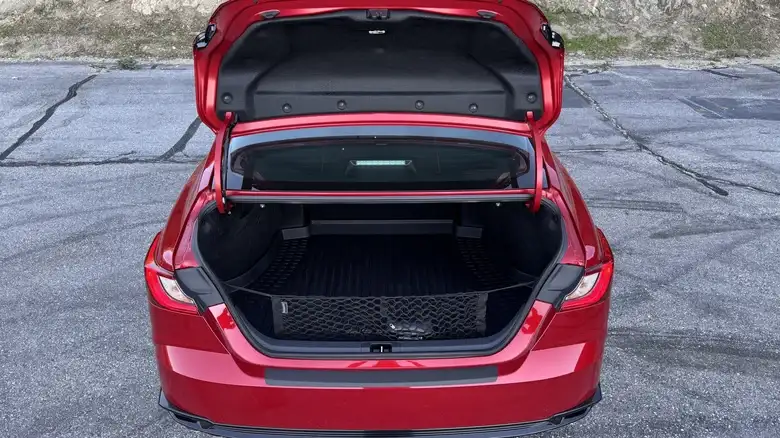
]The Camry’s low, long front overhang remains its most annoying practical flaw. It is the same old story in driveways, speed bumps, and parking stops: the nose sits close to the pavement, so careless approach angles can lead to scrapes. A front camera or surround-view system would help, but Toyota reserves that hardware for higher XLE and XSE trims. That is a meaningful omission because the Nightshade Edition is styled like a more premium variant yet still has to live with the same geometry compromises as the rest of the range.
On the road, Toyota’s standard driver-assistance suite is one of the Camry’s strongest ownership arguments. Full-speed adaptive cruise, lane tracing, blind-spot monitoring, lane departure assist, and automated emergency braking all come standard, and the cruise-plus-lane-trace combination works especially well in dense freeway traffic. In the real world, that makes the Camry feel less like a basic commuter and more like a tool that reduces fatigue on long, repetitive drives.
Market position and the numbers that matter more than the Nightshade badge
The Camry remains the best-selling car in America because it hits the values buyers actually pay for: efficiency, predictable ownership, and resale confidence. The Nightshade trim does not change that equation, but it does make the car easier to want. That distinction matters in a market where many mainstream sedans are trying to justify prices that keep drifting upward, while the Camry still presents itself as a rational purchase instead of a loyalty tax.
At roughly $36,000 as tested, the Nightshade Edition is still a lot of car, especially when you factor in Toyota’s hybrid system, standard active safety, and the likelihood of strong resale. The LE remains the smartest budget play, but the Nightshade gives the range a more emotionally appealing face without compromising the core package. It is a product defined by discipline, and that discipline is exactly why the Camry continues to dominate a segment many competitors have already abandoned.
Spec table for the 2026 TOYOTA CAMRY Nightshade Edition
| Item | 2026 TOYOTA CAMRY Nightshade Edition |
|---|---|
| Engine | 2.5-liter naturally aspirated inline-four hybrid |
| Total system output | 225 hp FWD, 232 hp AWD |
| Front electric motor | 134 hp |
| Rear electric motor | 40 hp AWD assist |
| Battery | 0.6-kWh lithium-ion |
| Transmission | eCVT |
| 0-100 km/h | About 7.0 seconds |
| Fuel economy | Up to 5.0 L/100 km combined-equivalent in LE FWD form |
| Wheels | 19-inch satin black alloy wheels |
| Tires | 235/40 Bridgestone Turanza |
| Standard audio | 6-speaker sound system |
| Base price | $33,795 including destination |
| Tested price | $35,878 |
The 2026 Toyota Camry Nightshade Edition is not the most entertaining sedan on sale, and it does not pretend to be. What it does offer is a rare combination of 232 hp, real efficiency, strong standard safety equipment, honest usability, and styling that finally gives America’s default sedan a little visual tension. In a market where too many cars ask for more money while delivering less substance, the Camry still looks like the adult in the room.