| Category | Specification | Data |
|---|---|---|
| Engine | C30A displacement and configuration | 3.0-liter naturally aspirated V6 with VTEC |
| Engine | C30A maximum power | 270 hp |
| Engine | C30A maximum torque | 284 Nm (210 lb-ft) |
| Engine | C32B displacement and configuration | 3.2-liter naturally aspirated V6 |
| Engine | C32B maximum power | 290 hp |
| Engine | C32B maximum torque | 304 Nm (224 lb-ft) |
| Transmission | Manual transmissions | 5-speed manual or 6-speed manual |
| Transmission | Automatic transmission | 4-speed automatic |
| Drive layout | Engine and driven wheels | Mid-engine, rear-wheel drive |
| Chassis | Body structure | All-aluminum monocoque |
| Suspension | Front suspension | All-aluminum double wishbone |
| Suspension | Rear suspension | All-aluminum double wishbone |
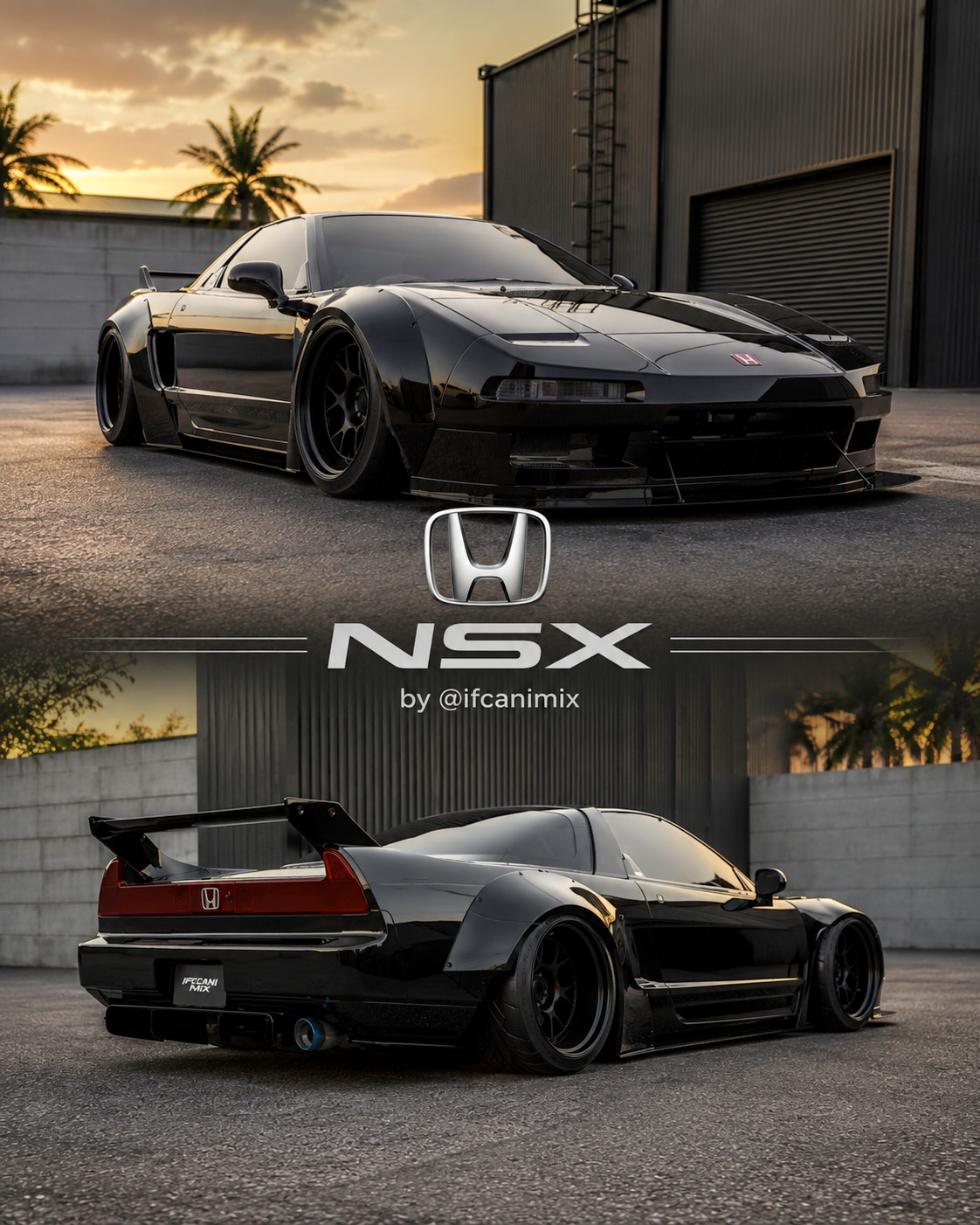
| Custom concept | Bodywork | Widebody front and rear overfenders |
| Custom concept | Front aerodynamic hardware | Deep front splitter with support rods |
| Custom concept | Rear aerodynamic hardware | High-downforce rear wing and rear diffuser |
| Custom concept | Exhaust layout | Single-exit rear exhaust |
| Custom concept | Lighting configuration | First-generation pop-up headlights |
POWERTRAIN ANALYSIS
The 3.0-liter C30A is a naturally aspirated V6 with VTEC, rated at 270 hp and 284 Nm (210 lb-ft). The 3.2-liter C32B V6 increases output to 290 hp and 304 Nm (224 lb-ft), producing gains of 20 hp and 20 Nm over the 3.0-liter configuration.
The NSX uses a mid-engine, rear-wheel-drive layout. Transmission availability includes a 5-speed manual, a 6-speed manual, and a 4-speed automatic. The 6-speed manual transmission is paired with later NA2 3.2-liter C32B models.
The C30A and C32B configurations use naturally aspirated induction. The C30A specification incorporates VTEC variable valve timing and lift control, while the 3.2-liter C32B configuration supplies the highest listed NSX output at 290 hp and 304 Nm.
CHASSIS & DYNAMICS
The first-generation NSX uses an all-aluminum monocoque body structure. This construction established the NSX as the first mass-produced vehicle with an all-aluminum monocoque body and provides the primary structural architecture for the mid-engine layout.
Front and rear suspension use all-aluminum double-wishbone geometry. The four-wheel double-wishbone arrangement combines aluminum suspension components with the aluminum monocoque structure.
Chassis dynamics and suspension geometry received development feedback from three-time Formula 1 World Champion Ayrton Senna. The chassis specification combines mid-engine rear-wheel-drive packaging, all-aluminum structure, and double-wishbone suspension at both axles.
The custom widebody concept adds expanded front and rear overfenders, a deep front splitter supported by rods, a high-downforce rear wing, and a prominent rear diffuser. The concept retains pop-up headlights and uses a single-exit exhaust integrated within the rear diffuser area.
COMPARATIVE DATA
| Specification | NSX 3.0L C30A | NSX 3.2L C32B NA2 |
|---|---|---|
| Engine | 3.0-liter naturally aspirated V6 with VTEC | 3.2-liter naturally aspirated V6 |
| Maximum power | 270 hp | 290 hp |
| Maximum torque | 284 Nm (210 lb-ft) | 304 Nm (224 lb-ft) |
| Power difference | — | +20 hp |
| Torque difference | — | +20 Nm |
| Manual transmission availability | 5-speed manual | 6-speed manual |
| Drive layout | Mid-engine rear-wheel drive | Mid-engine rear-wheel drive |