
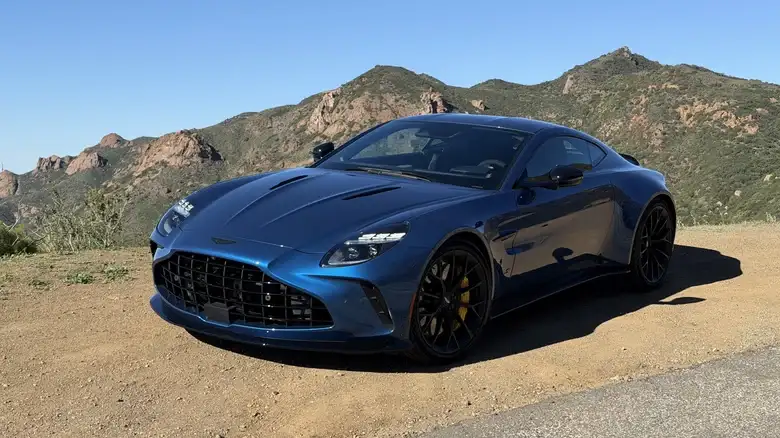
The Aston Martin Vantage S Arrives With a Clear Message
Aston Martin did not build the Vantage S to be polite. The moment the AMG-derived 4.0-liter twin-turbo V8 fires, the car defaults into Sport, not Comfort, not GT, and not any version of digital softness. That choice frames the entire car: the Vantage S is a 202-mph grand tourer that treats every driveway exit like a warm-up lap, and every on-ramp like an invitation to embarrass less committed machinery. In a market where the Ferrari Purosangue Handling Speciale and Lamborghini Urus SE Larte chase drama in different forms, Aston’s answer is simpler: remove the safety net and sharpen the edges.
The Vantage S is not a parts-bin special. Its 671 hp, 800 Nm and Sport-first calibration create a more urgent personality than the standard Vantage, while the chassis changes preserve the car’s daily range of motion. That balance is what separates it from heavier, more insulated rivals such as the Mercedes-Benz E-Class Night Edition.
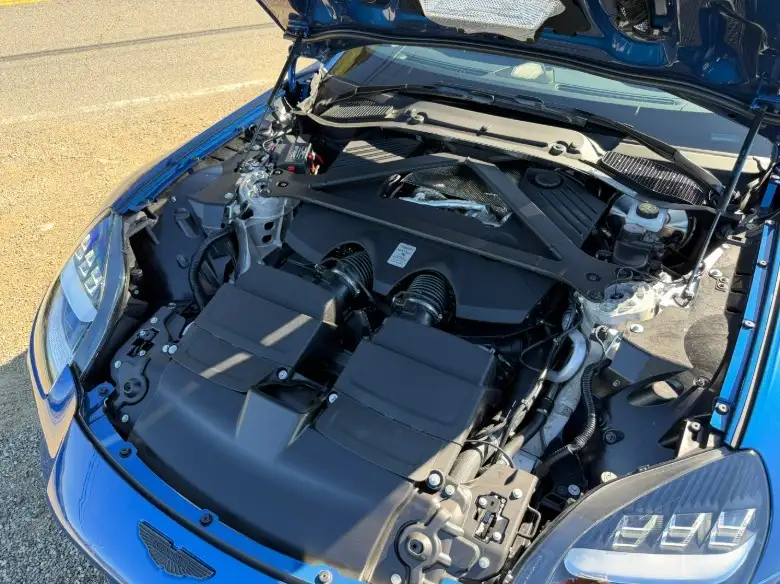
Powertrain Upgrade Means More Than 15 HP
The headline number is modest: output rises from 656 hp to 671 hp, while torque remains fixed at 800 Nm (590 lb-ft). The more important change is calibration. Aston revised throttle mapping so the engine reacts more aggressively in each drive mode, and that is what the Vantage S feels like in motion: not merely stronger, but more immediate. The official performance claim stays close to the base car at 3.3 seconds to 100 km/h and 10.1 seconds to 200 km/h, yet the car’s midrange punch is what defines the experience, especially when the gearbox drops a ratio and the V8 surges with a hard-edged shove.
This generation’s V8 is already familiar from AMG applications, but Aston has tuned it into a more rev-hungry and more reactive unit than many buyers expect from a 4.0-liter twin-turbo layout. The sound is not manufactured by gimmickry or speaker trickery. It is a real, mechanical bark that stays present across the rev range, helped by the car’s baseline drive character and the lack of a muted everyday setting. Against that backdrop, even cars like the Cadillac CT5-V Blackwing F1 Collector Series look like they are playing a different game: more power is not always more emotional.
A 15 hp increase rarely changes the personality of a 671 hp coupe by itself. Here, the real gain comes from throttle response and mode-specific mapping, which make the engine feel sharper from low rpm to redline. That same principle explains why tuned special editions such as the ABT Audi A6 Avant C9 can feel more transformed than their paper specs suggest.
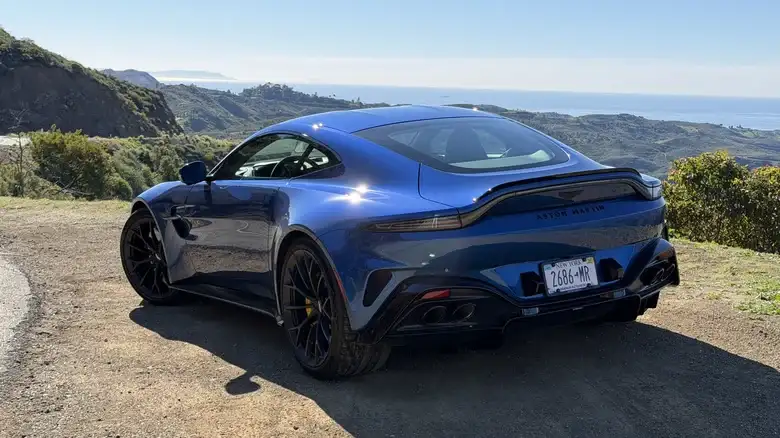
The Chassis Changes Target Turn-In, Not Just Lap Times
Aston Martin did not rewrite the Vantage S from the ground up, but the engineering changes are deliberately targeted. The rear subframe is now mounted directly to the body rather than through rubber bushings, which should tighten the car’s responses at the rear axle. Bilstein adaptive dampers receive revised hardware and software, and Aston also altered camber, caster and toe. Those are the kind of changes that affect a car’s first millisecond of response, not just its end-of-straight numbers.
What comes through on a narrow Malibu canyon road is a front end that is more accurate and more willing to load up early in the corner. The Vantage S still occupies a physically large footprint, and outward visibility remains limited, but it attacks tight pavement with more confidence than the standard car. The steering has better weighting and the chassis feels more settled when you transition quickly from brake to turn-in to throttle.
The biggest handling gain comes from stacking several small revisions: a stiffer rear interface, revised damping, and alignment changes. Aston did not chase gimmicks like rear-wheel steering. Instead, it leaned on fundamentals, the same way performance sedans such as the Alfa Romeo Giulia and Stelvio Borrow Quadrifoglio Tricks use chassis tuning to mask platform age.
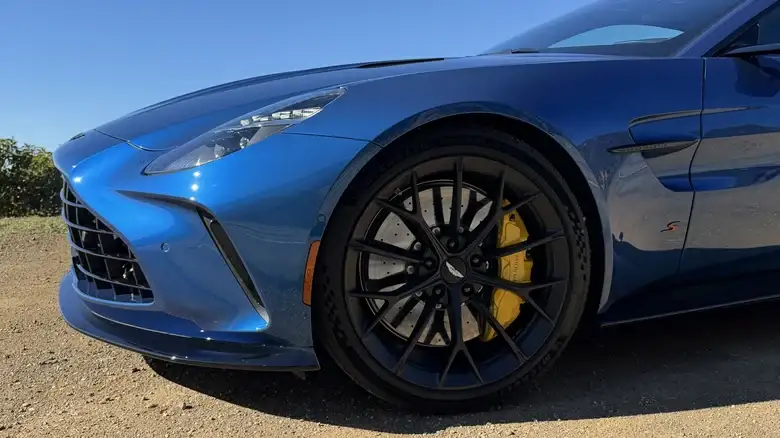
Aerodynamics and Tires Give the Vantage S Its Bite
The S-specific ducktail spoiler is not just a styling flourish. Aston says it adds 97 pounds of downforce at the car’s top speed and shifts the aero balance forward for better turn-in and front-end grip. That may not be something you can “feel” as a single number at street speeds, but the directional stability and eagerness to rotate are consistent with the claim. The car rides on Aston-specific Michelin Pilot Sport S 5 tires, with a staggered setup of 275/35 ZR21 up front and 325/30 ZR21 at the rear.
The result is a coupe that feels more planted without becoming numb. The Vantage S still tramlines, and 21-inch wheels will never be kind to broken pavement, but the ride quality remains within the same broad envelope as a Porsche 911 GTS. The aerodynamic and tire package does its best work when you are asking for lateral grip in second- and third-gear corners, where the car’s nose settles quickly and the rear tires bite with reassuring force.
The Vantage S is not trying to become an all-weather luxury coupe. It is a focused road car with 97 pounds of extra top-speed downforce and sticky Michelin S 5 rubber, which is exactly why it feels so eager in real canyon driving. For a different kind of high-performance hardware discipline, look at the Porsche 911 GT3 Artisan Edition.
Sport Is the Baseline, and That Changes Everything
The drive-mode structure tells you almost everything about the car’s priorities. The regular Vantage offers GT, Sport, Sport+ and Wet, but the Vantage S begins at Sport and climbs through Sport+ to Track, with Wet and Individual also available. There is no Comfort mode to hide behind. Even so, the car is not intolerable in traffic because Aston reduced transmission-mount stiffness by 10% and softened the rear spring aid for better low-speed compliance.
That duality is the Vantage S’s strongest argument. It can feel aggressive enough to chase supercar energy on a good road, yet calm enough to commute without punishment. The transmission, an 8-speed automatic with large paddles, shifts with a decisive kick in the more aggressive modes and still behaves intelligently in automatic mode. It is a setup that suits the car’s character better than a soft-first or grand-tourer-first calibration ever could.
Interior, Price and the Market Fight
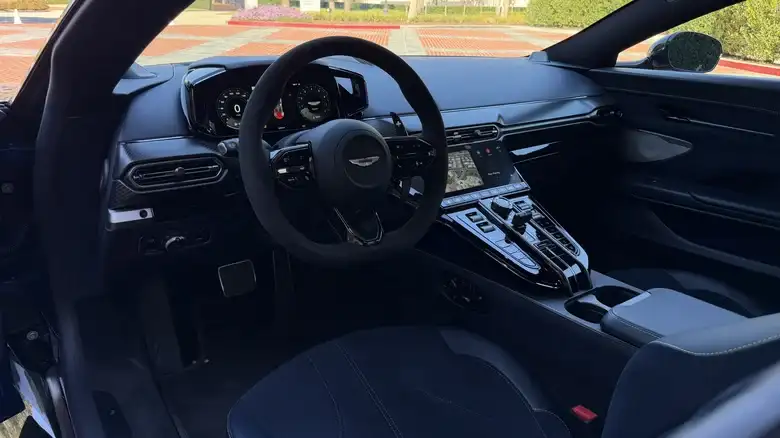
Aston has also improved the broader Vantage package with the facelifted cabin and better perceived build quality, even if the infotainment still lags behind the class leaders. The Vantage S starts at $199,500 in the United States, including destination but excluding a $7,400 import-costs tariff fee listed on the window sticker. That places it in striking distance of the RML GT Hypercar’s more extreme halo territory, while staying below many optioned super-GT alternatives once their packages and carbon-ceramic brakes are counted.
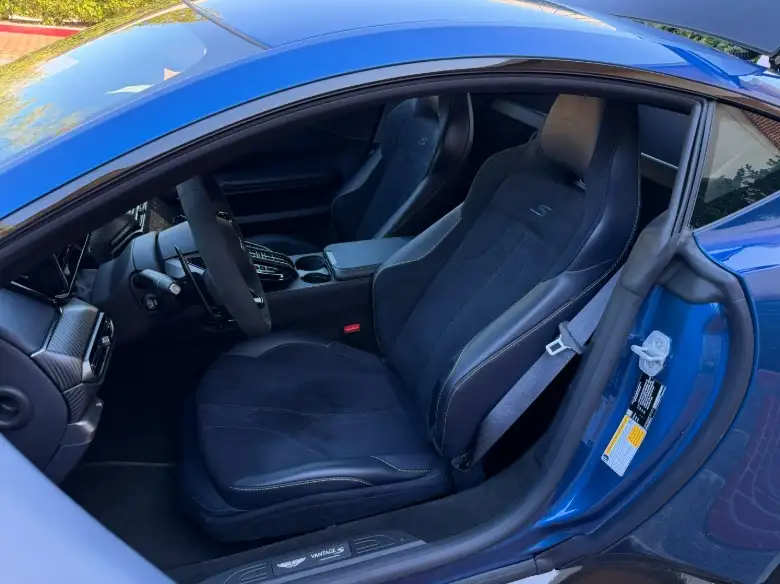
Aston’s own demo car, painted Plasma Blue, climbed to $248,400 with options including a $10,000 Bowers & Wilkins audio system, $10,800 carbon-ceramic brakes, $2,900 contrast stitching and $1,900 ventilated seats. The price escalation is familiar in this class, but the Vantage S remains compelling because the core experience is so concentrated. Unlike more prestige-heavy machines that can feel engineered for the spec sheet, the Aston is engineered for the first throttle input.
The Vantage S is stronger because Aston resisted overcomplication. It added 15 hp, revised aero, changed mounting strategy and refined damping instead of chasing a full reinvention. That strategy mirrors the appeal of focused special editions such as the Maserati Grecale Modena Nero Infinito, where restraint can make the spec feel more coherent.
Why the Vantage S Feels So Immediate on the Road
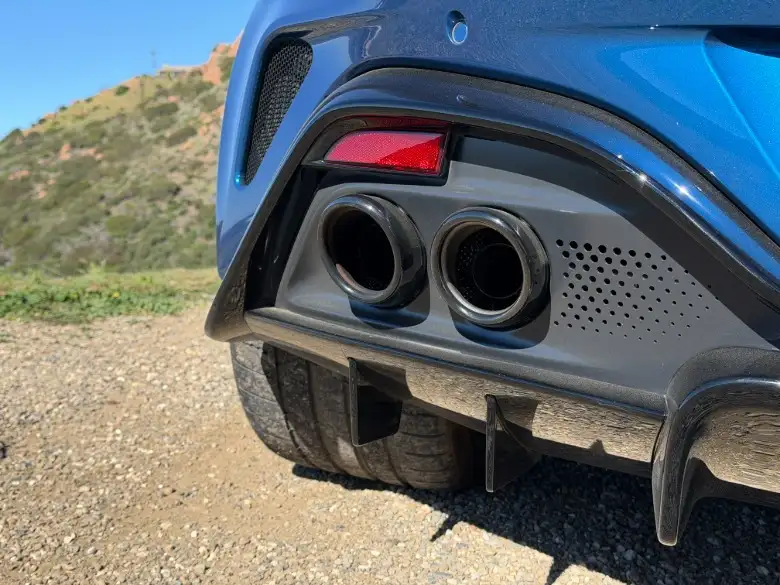
The most convincing part of the Vantage S is how quickly it wakes up your senses at any speed. Pulling into a gap in traffic, exiting a corner, or short-shifting at the right moment all produce the same reaction: the car lunges, the rear tires squirm and the exhaust reacts with a hard, metallic urgency. That response profile is why the Vantage S feels more alive than many faster cars that isolate the driver behind layers of damping and software logic. If Aston’s goal was to create a coupe that feels muscular, alert and unfiltered, the company has succeeded.
For enthusiasts cross-shopping this against the Porsche 911 GTS, Mercedes-AMG GT63 and similar rear-drive performance coupes, the key takeaway is simple. The Vantage S does not win by being the most polished machine in the segment. It wins by making every small movement feel amplified and every straight road feel shorter. That is not just a product of horsepower. It is the result of a chassis, aero and calibration package tuned to keep the driver engaged from the first mile to the last.
| Specification | 2026 Aston Martin Vantage S |
|---|---|
| Engine | 4.0-liter twin-turbo V8, AMG-derived |
| Power | 671 hp |
| Torque | 800 Nm (590 lb-ft) |
| Transmission | 8-speed automatic |
| Drive | Rear-wheel drive |
| 0-100 km/h | 3.3 seconds |
| 0-200 km/h | 10.1 seconds |
| Top speed | 325 km/h (202 mph) |
| Wheels | 21-inch |
| Front tire size | 275/35 ZR21 |
| Rear tire size | 325/30 ZR21 |
| Base price in the U.S. | $199,500 |
| Observed test price | $248,400 |
| Key hardware and calibration changes | Vantage S specifics |
|---|---|
| Drive modes | Wet, Sport, Sport+, Track, Individual |
| Rear subframe mounting | Mounted directly to the body |
| Dampers | Revised Bilstein adaptive hardware and software |
| Alignment changes | Camber, caster and toe revised |
| Transmission mount stiffness | Reduced by 10% |
| Rear spring aid stiffness | Reduced for low-speed ride quality |
| Rear spoiler effect | 97 pounds of downforce at top speed |