| Category | Specification |
|---|---|
| Model Year | 1963 |
| Production | 5 prototype cars |
| Engine | All-aluminum small-block V8 |
| Displacement | 377 cu in (6.2 L) |
| Induction | Four Weber twin-choke side-draft carburetors |
| Intake Manifold | Aluminum cross-ram manifold |
| Maximum Power | Approximately 485-550 HP at 6,400 rpm |
| Transmission | Close-ratio 4-speed manual |
| Drive Layout | Rear-wheel drive |
| Differential | Heavy-duty limited-slip differential |
| Curb Weight | Approximately 1,900 lb (860 kg) |
| Weight-to-Power Ratio | 3.45-3.92 lb/HP |
| Chassis | Modified tubular steel frame |
| Body Construction | Hand-laid thin fiberglass body panels |
| Front Suspension | Independent race suspension with heavy-duty anti-roll bar and specialized shock absorbers |
| Rear Suspension | Independent race suspension with heavy-duty anti-roll bar and specialized shock absorbers |
| Brakes | Four-wheel disc brakes with sintered metallic pads and cooling ducts |
| Tires | Wide Goodyear racing tires |
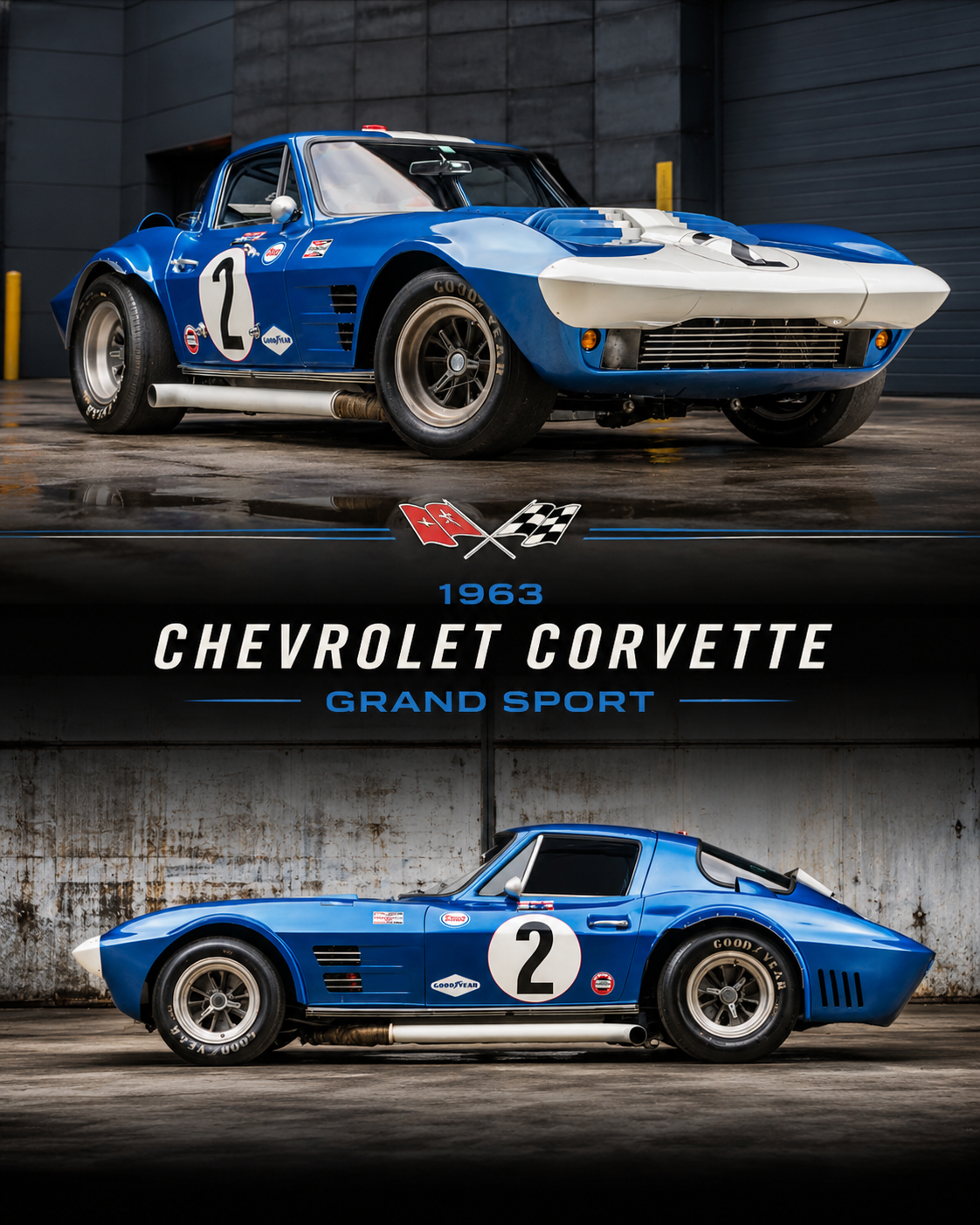
| Aerodynamic Equipment | Vented hood, front heat extractors, rear oil-cooler scoops, flared fenders, and side-exit exhaust |
Powertrain Analysis
The 1963 Chevrolet Corvette Grand Sport used a 377 cu in, or 6.2 L, all-aluminum small-block V8. Its naturally aspirated induction system combined four Weber twin-choke side-draft carburetors with an aluminum cross-ram intake manifold. Output ranged from approximately 485 HP to 550 HP at 6,400 rpm.
A close-ratio 4-speed manual transmission transferred power to the rear wheels. The rear axle used a heavy-duty limited-slip differential, providing locked torque distribution across the driven wheels under race-load conditions.
At an approximately 1,900-lb curb weight, the 485-HP configuration produced a 3.92-lb/HP ratio. At 550 HP, the power-to-weight figure improved to 3.45 lb/HP, placing the prototype in a substantially lighter weight class than a standard production C2 Corvette.
Chassis and Dynamics
The chassis used a modified tubular steel frame engineered for torsional rigidity and racing loads. The hand-laid fiberglass body employed ultra-thin panels, reducing mass by roughly 1,000 lb relative to a standard production C2 Corvette.
Independent front and rear race suspension systems used heavy-duty anti-roll bars and specialized shock absorbers. The suspension specification prioritized wheel control under high lateral load while supporting the wide Goodyear racing tires fitted beneath the extended fender arches.
Braking hardware consisted of heavy-duty disc brakes at all four wheels. Sintered metallic pads and dedicated cooling ducts supported repeated braking loads. The vented hood incorporated front heat extractors, while rear air scoops supplied airflow to rear differential oil coolers.
The bodywork used flared wheel arches, a heavily vented hood, rear cooling scoops, and rocker-mounted side-exit exhaust pipes. The side-exit exhaust layout reduced exhaust restriction and positioned the system outside the main underbody airflow path.
Race Cockpit
The cockpit used lightweight aluminum bucket seats with racing harnesses and an integrated roll cage structure. A three-spoke wood-rimmed steering wheel controlled the front wheels, while high-visibility analog instrumentation displayed oil pressure, water temperature, and engine speed.
Sound-deadening material, carpeting, door-glass mechanisms, and interior trim were deleted. The reduced-equipment cabin configuration supported the approximately 1,900-lb curb weight and retained only race-critical controls, gauges, seating, and safety equipment.