
Humanoid robot takes on critical position with 90% success rate and industrial cadence. Understand the impact on EV production.
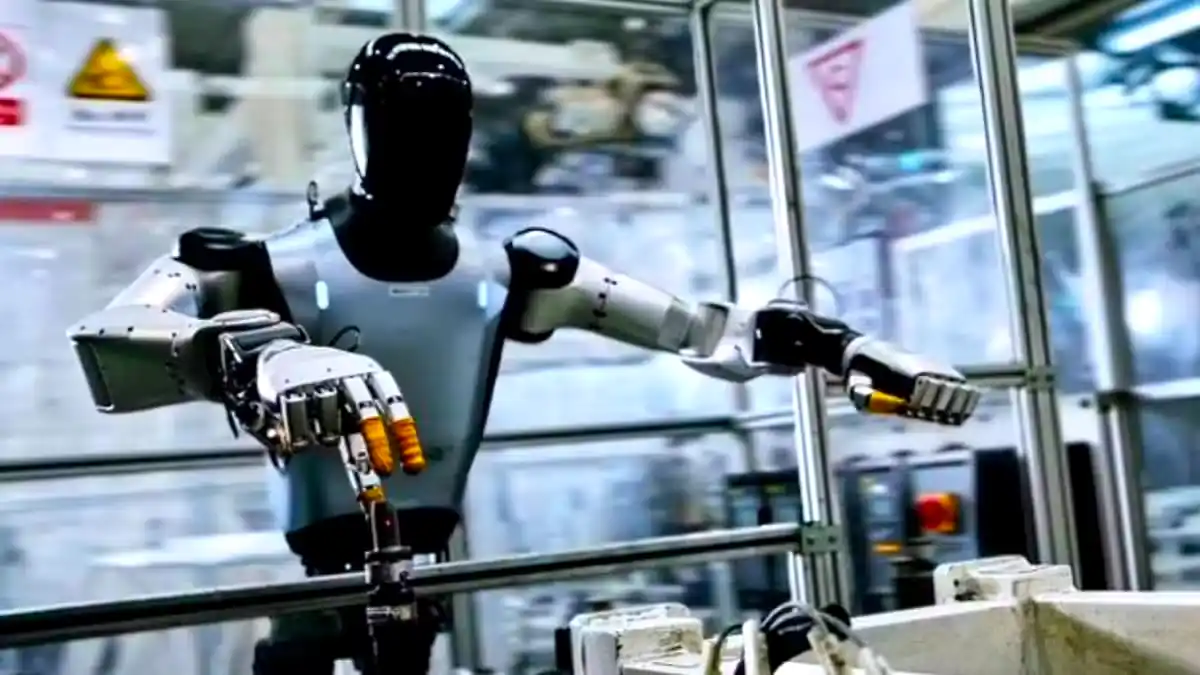
What Xiaomi Really Put to Work on the Assembly Line
Xiaomi brought its humanoid robotics project inside an electric car factory and chose a task that allows no mistakes: installing self-locking nuts at an assembly station connected to the die-casting process. The point is not just to “pick and place.” The industrial challenge here is to meet cadence, maintain repeatability, and sustain yield without an operator correcting micro-failures every cycle.
In tests released by the brand, the robot operated autonomously for 3 consecutive hours at the station, achieving a 90.2% success rate in simultaneous installation on both sides while still respecting the 76-second cycle time required by the line. On the factory floor, this number marks the boundary between a “cute prototype” and a “scale candidate.”
When a humanoid can maintain production cycle and accuracy rate for hours, the discussion stops being aesthetic and becomes a matter of factory economics.
This move aligns with Xiaomi’s broader automotive strategy, which has previously flirted with the imagery of performance and design in projects like the XIAOMI VISION GT and the brand’s European play. The difference is that now the “bet” is on the hardest place to impress: the assembly line.
Why Installing Self-Locking Nuts Is a Nightmare for Robots
In theory, it seems simple: pick up the nut from an automatic feeder, position it in the jig, and coordinate the tightening. In practice, Xiaomi highlights three complicating factors that greatly increase the likelihood of failure:
- Millimeter alignment for correct engagement, especially in fittings with tight tolerance.
- Non-fixed grip posture, as the nut can arrive in different orientations, requiring adaptation by the end operator.
- Magnetic interference, which can “pull” or slightly divert the piece and compromise the seating.
For readers following EVs, it is worth noting how this obsession with cadence resembles another bottleneck in the electric world: time. The same logic driving the race for ultra-fast charging appears in manufacturing. One example is the competition for minutes in the battery, as we showed in solid-state batteries with 80% charge in 4.5 minutes. In the factory, “minutes” become “seconds” per cycle.
The Technology Behind the Humanoid and the Silent War Against Tesla and Xpeng
What gives this test its strength is the control approach. Xiaomi describes a end-to-end data-driven system, supported by a large VLA-type (Vision-Language-Action) model with 4.7 billion parameters, called Xiaomi-Robotics-0, combined with reinforcement learning. In practical terms, this aims to reduce dependence on teleoperation (human guiding the robot) and accelerate adaptation to real-world variations.
Besides vision, multimodal signals are integrated to close the machine’s “sense of reality”:
- Vision to locate parts and templates.
- Touch to perceive contact, seating, and micro-locks.
- Joint proprioception to understand position, effort, and stability of the entire body.
In motion control, the brand mentions a hybrid architecture, mixing optimization with reinforcement learning. One detail that stands out is the promise to solve iterations of the optimization controller in less than 1 millisecond, an important condition to maintain real-time response in an industrial environment.
According to Xiaomi, “robustness training” involves simulation with hundreds of millions of random disturbances in a virtual environment, so the robot learns to maintain balance under disturbances and transfer that to the real world with minimal adjustments. This point is vital because a humanoid that loses stability not only fails the task: it becomes an operational risk.
The backdrop is competitive. Tesla has been pressuring with Optimus and the promise of more complex tasks in the short term, while Xpeng is accelerating plans for a mass production base. By placing the humanoid on a real production line station, Xiaomi signals an aggressive thesis: humanoid robotics as a manufacturing advantage, not just as a parallel product.
And this ties directly to another industry shift: EVs are not just battery and motor, but also production and scale. If you like to see how brands are redesigning strategy to compete with giants, it’s worth comparing with what we analyzed in SC-01 and Xiaomi DNA with European production in Italy and also with the direct fight for market dominance in electric vehicles in the crossover targeting the Tesla Model Y at a lower price.
| Indicator | What it means in practice |
|---|---|
| 3 hours of autonomous operation | Minimum consistency to become an industrial pilot and not just a demonstration |
| 90.2% success rate | Performance still evolving, but already measurable and comparable |
| 76 s cycle time | Compatibility with the line cadence, an essential condition to scale |
| VLA 4.7B parameters | Cognitive basis for generalization, interpretation, and sequential action |
The final message is clear: Xiaomi doesn’t just want to manufacture electric cars; it wants to manufacture how the factories of the future will operate. And when the CEO projects “large quantities” of humanoids working over the next five years, the bet is not on science fiction but rather on reducing the most expensive bottleneck in the modern automotive industry: cycle time with high yield.