
Ignoring suspension costs you a fortune! Discover why driving with bad shocks increases braking distance by up to 30%, destroys tires, and poses a real threat to your life. Auto Suspension Repair and maintenance are crucial for US road safety.
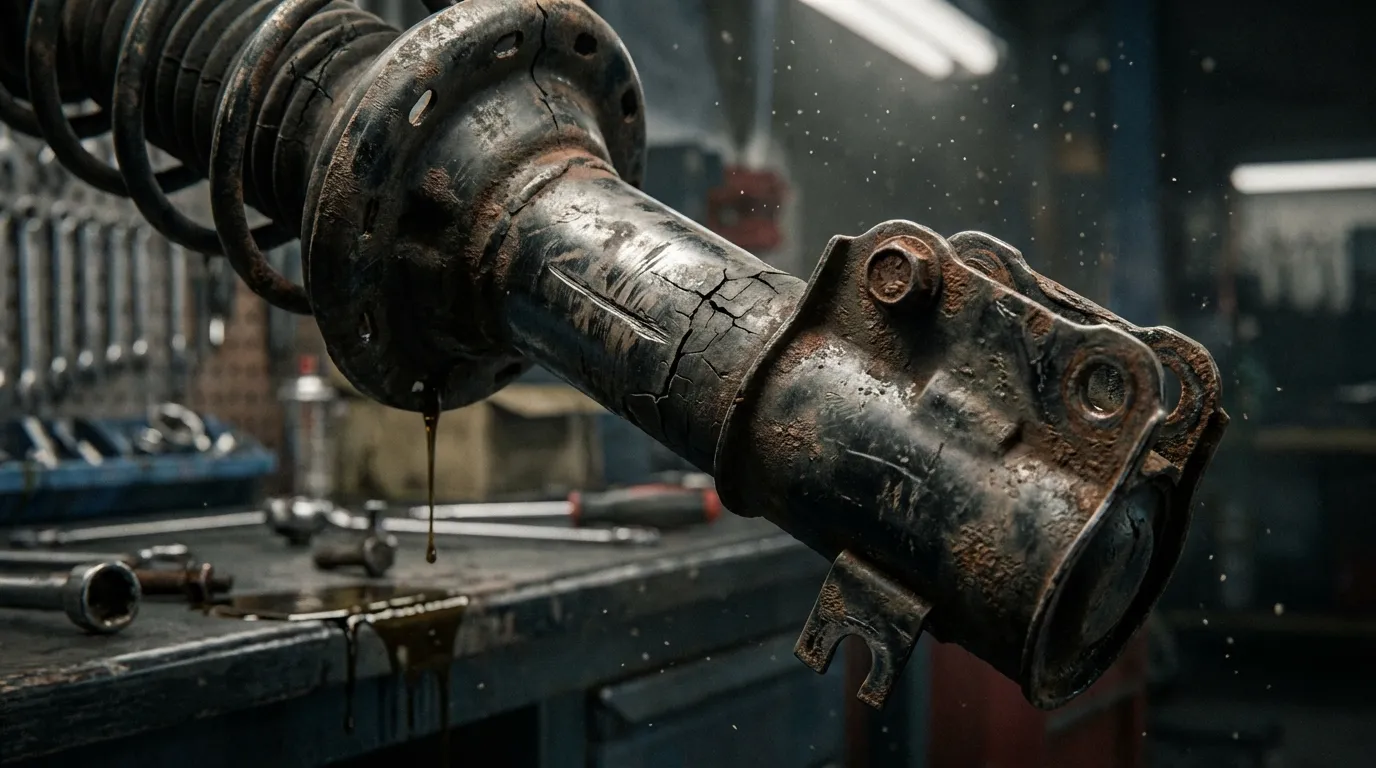
Have you ever felt your car “float” strangely after passing over a speed bump or heard that irritating metallic squeak coming from the wheels? If yes, you might be sitting on a mechanical time bomb. It is common, during tight budget times, to look at the car’s suspension and think: “It can hold on for a few more miles.” However, neglecting worn shocks or struts is not just a matter of comfort; it is a decision that directly affects your wallet and, worse, your physical safety. What seems to be a “saving” now inevitably turns into a nightmare of tripled costs and serious accident risks in a matter of months. Prioritize suspension diagnostics.
The Domino Effect: How Bad Suspension Destroys the Rest of the Car
Automotive engineering works like an ecosystem. No part works in isolation. When shocks lose the ability to absorb the kinetic energy from road irregularities, this energy doesn’t disappear; it’s violently transferred to other components that were not designed to support such loads. This is where your bank account starts to bleed. Ensure your local auto shop checks related components.
The first component to call for help is the tires. With worn shocks, the wheel does not stay firm against the road; it “bounces.” This oscillating movement causes the rubber to contact the asphalt intermittently and irregularly, creating a wear pattern known as “scalloping” or cupping. Tires that should last 60,000 miles can become unusable in half that mileage. Understanding the evolution of components is crucial; why car tires abandoned inner tubes was a safety revolution, but not even the best tubeless technology can withstand a destroyed suspension system.
Besides tires, excessive impact pounds the suspension bushings, pivots, steering ends, and even engine mounts. What could be a simple replacement of a pair of shocks can escalate into a complete front assembly rebuild. Imagine the scenario: you saved money on shock replacement but now need to realign the steering constantly because the car can’t maintain its geometry. It’s a mathematical paradox for vehicle maintenance.
The Physics of Danger: Braking and Control Compromised
If the financial aspect isn’t enough to convince you, the ruthless physics of road safety should be. The role of the shock absorber is to keep the tire glued to the ground. If the tire isn’t on the ground, you lose traction, steering ability, and crucially, braking capability. This impacts your driving safety in the US.
Studies indicate that shocks with only 50% efficiency can increase braking distance by up to 20% to 30%. On a 50 mph road, this means gaining precious feet that can be the difference between a scare and a fatal collision. This occurs due to the “nose dive” phenomenon. When braking, the car’s weight shifts forward. Bad shocks fail to control this transfer, causing the front to dip excessively and the rear to lift, unbalancing braking. Even if you’re unsure about whether to do full brake maintenance, like the common question about replacing all four brake pads, remember: new brakes on a worn suspension drastically lose their efficiency.
Another invisible danger is hydroplaning. On rainy days, excessive wheel oscillation prevents the tire from cutting through the water layer. The result is a total loss of control, much earlier than in a vehicle with proper suspension. And let’s not forget curves: excessive body roll makes the car unstable, slow to respond, and prone to skidding or even rolling over in emergency maneuvers. High-performance cars, like the Porsche 911 GT3 with coilover suspension, invest millions in technology precisely to prevent this, proving that stability is synonymous with survival. Proper suspension tuning matters.
Driver Fatigue and Diagnosis: Don’t Wait for the Worst to Happen
Driving a “blow-up castle” on wheels isn’t just unsafe for the car; it’s exhausting for the driver. Constant vibration and the need to make micro-adjustments on the steering wheel all the time cause physical and mental fatigue to accelerate. On long trips, this is an invitation to disaster. Fatigue behind the wheel accounts for about 20% of accidents, acting on the brain similarly to mild intoxication. Protect your family’s safety.
But how do you know when it’s time? Your car talks to you, you just need to learn to listen.
- The Bounce Test: With the car stopped, push forcefully on one corner downward and release. The car should rise and stabilize immediately. If it continues bouncing (rebounds) more than one and a half times, the shock is done for.
- Visual Inspection: Look behind the wheel. If you see oil leaking from the shock body, the seal has broken and it’s inoperative. Look for shock absorber leaks.
- Irregular Wear: Run your hand along the tire tread. If you feel undulations (like saw teeth), it’s a classic sign of inefficient suspension. Check your tire tread wear patterns.
Often, drivers are misled by low-quality parts or incorrect diagnoses. Just as there are scams with fake ignition coils that can melt your engine, there are reconditioned suspension components that offer no safety at all. Always opt for reputable brands and trusted mechanics for suspension replacement services.
In summary, suspension is what connects your machine to the real world. Ignoring its signals is like ignoring chest pain hoping it will pass on its own. The cost of a pair of shocks is infinitely less than the cost of an accident, premature new tires, or losing control in a critical situation. In a world where technology advances to save us time in traffic, like the GPS that makes traffic lights smart, don’t let basic maintenance neglect become the reason for your delay — or your absence. Schedule your suspension checkup today.