
A 4-cylinder engine with 8 spark plugs seems like overkill… until you understand that the idea isn’t to “double the power,” but to burn fuel better, with less loss, less detonation, and often, fewer emissions.
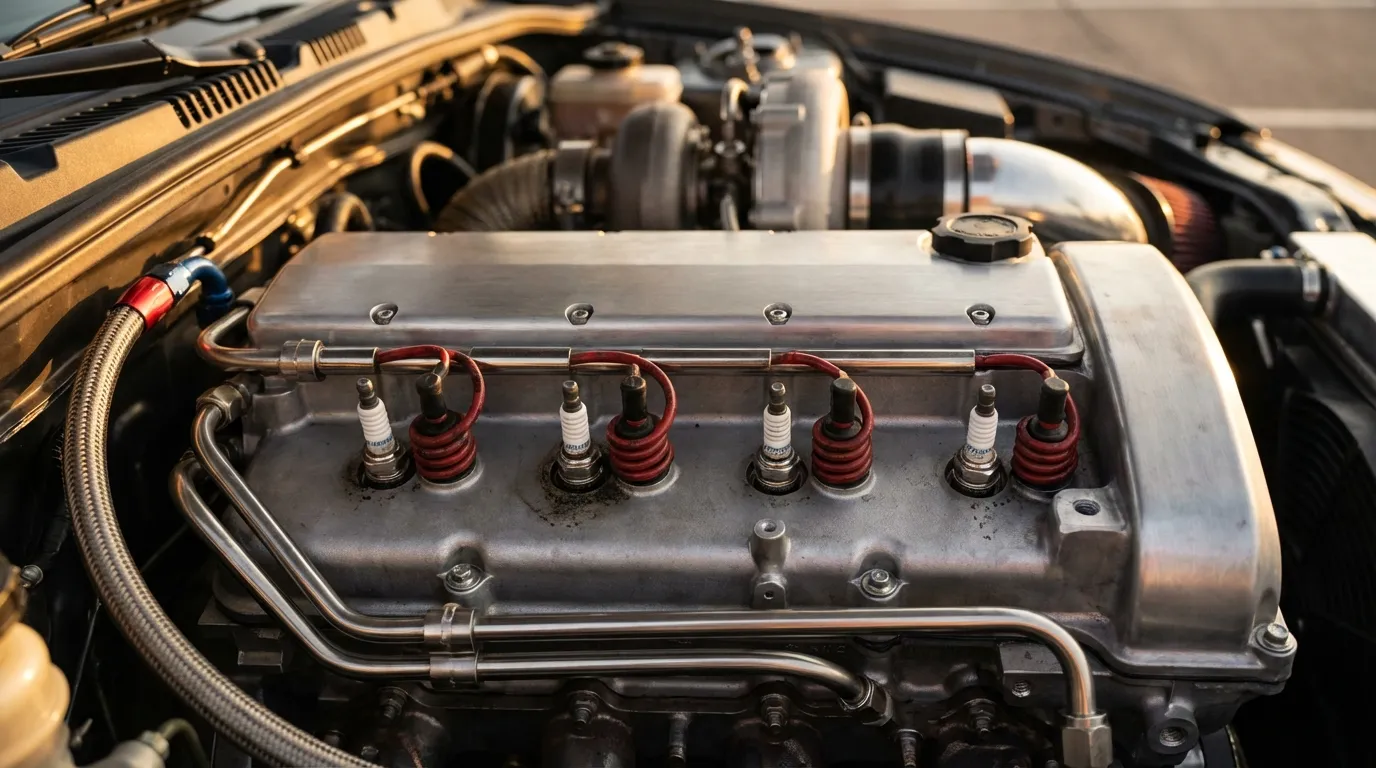
What Does It Mean For A 4-Cylinder Engine To Have 8 Spark Plugs?
In most gasoline cars, the math is simple: 1 cylinder = 1 spark plug. But in some designs, each cylinder receives two spark plugs (or “twin spark,” “dual spark,” “dual ignition”). In practice, this creates two flame fronts inside the combustion chamber.
This architecture can work in two ways:
- Simultaneous ignition: both plugs fire almost at the same time to accelerate the flame front.
- Sequential ignition: one plug fires before the other, according to RPM, load, and ECU strategy, refining the burn in different situations.
In other words: a 4-cylinder with 8 plugs is not inherently “a stronger engine.” It is an engine with more control over combustion.
Why Does This Exist (And Why Isn’t It New)
Automotive engineering rarely arises for aesthetic reasons. Dual ignition appeared very early in history, mainly in engines with large chambers and difficult flame propagation. In older (and some modern) designs, the distance the flame needs to travel inside the cylinder can be large enough to:
- make combustion slow under certain conditions;
- increase the chance of unburned mixture;
- increase emissions and consumption;
- raise the risk of knock (detonation) when trying to compensate with more advance.
With two well-positioned plugs, the burn tends to be faster and more complete. This isn’t “magic”: it’s combustion geometry.
Why Some 4-Cylinder Engines Use 8 Spark Plugs: The Real Reasons
If you search “Why Some 4-Cylinder Engines Use 8 Spark Plugs,” you will find simplistic answers like “to generate more power.” In part, that can happen. But the reasons manufacturers actually adopt 8 plugs in 4 cylinders are usually these:
1) Faster (And More Complete) Combustion
Inside the cylinder, the plug doesn’t “explode” the fuel: it initiates a flame kernel that grows and spreads. In some chambers, this growth can be slow because of:
- chamber shape and plug position;
- turbulence and port design;
- lean burn mixture or EGR;
- load and RPM variation.
With two ignition points, the average distance the flame travels decreases. Typical result: less unburnt fuel turning into strong odors, soot, HC, and CO.
If you want to delve deeper into how “small parts” make a big difference, it’s worth reading Brand Motor Oil Vs. Store Brand Motor Oil: Does It Even Make a Difference in Brazil? because the reasoning is similar: real efficiency comes from the details.
2) More Efficiency And Economy Without Needing To “Push It”
One of the smartest uses of dual ignition is allowing the engine to operate well with:
- leaner mixtures at cruising speed;
- more aggressive compression ratios;
- safer ignition timing advances in certain ranges;
- stable combustion at low RPMs.
This tends to result in lower consumption and often reduced emissions, without relying solely on “more pressure” (turbo) or enriching the mixture to cool the cylinder.
3) Less Risk Of Detonation (Knock)
Detonation is one of the “monsters” of gasoline engines: it can break rings, crack pistons, and destroy bearings. When combustion is slow, you usually need to advance the timing further to extract efficiency. But advancing too much increases the risk of knock.
With two plugs, combustion can happen in less time, requiring less advance in critical situations. This helps keep the pressure in the cylinder where it matters: at the right moment.
And if you like understanding how ignition evolved into modern systems, here is an essential deep dive: Why Cars Swapped Distributors for Coil Packs: The Change That Made Engines Stronger and More Economical.
4) Lower Emissions (The “Quiet” Reason)
A lot of automotive technology is born for an unglamorous reason: environmental regulations. More complete burning can reduce unburned hydrocarbons (HC) and carbon monoxide (CO). In certain designs, dual ignition helps maintain stable combustion in conditions that would normally “dirty” the burn.
This is why some dual ignition systems are tuned to act differently at low load, idle, and in urban traffic, where efficiency usually plummets.
5) Redundancy (Yes, That Matters Too)
In engineering, redundancy means continuity of operation. If one plug fails, there is still another in the same cylinder to keep the engine running (perhaps with faults, but running). This logic is so important that it even appears in aircraft engines, where reliability is the absolute priority.
In real life, this doesn’t mean you can ignore maintenance. It just means that, in some cases, the system is more tolerant of single point failures.
Advantages And Disadvantages Of The 4-Cylinder With 8 Spark Plugs (No Fluff)
Dual ignition is a solution, not a miracle. And like any solution, it exacts a price somewhere.
| Aspect | What Improves | What Worsens |
|---|---|---|
| Combustion | Faster, more stable burn, less misfire in difficult conditions | More complex design for chamber, camshaft, and ECU strategy |
| Consumption | Potential savings at low load and urban use | Gain depends on calibration; it is not “guaranteed” in all uses |
| Emissions | Less HC/CO in specific scenarios | More components requiring maintenance |
| Maintenance | Redundancy can prevent immediate breakdown with one bad plug | Double the spark plugs and, in some cases, more coils and more labor |
The “Hidden Cost”: Doubled Maintenance And More Annoying Diagnostics
When the engine has 8 plugs, you have (surprise): 8 plugs to change. Depending on the car, you might also have:
- more coils (or a more complex coil system);
- more connectors, wiring harnesses, and failure points;
- more labor time, especially if plug access is poor.
A detail many people ignore: misfire isn’t always a “bad plug.” It could be the coil, the injector, a vacuum leak, a sensor, or sub-standard fuel. If you want to avoid falling into common shop traps, this content is a useful wake-up call: Maintenance Mistakes That Are Making Your Mechanic Rich and Jeopardizing Your Safety.
More Coils = More Expense (In Some Designs)
Not every dual ignition engine uses “one coil per plug,” but many modern systems have moved toward individual coil packs. And coils are components subject to heat, vibration, and aging.
By the way, before rushing to buy parts, here’s a warning: the spark plug market has heavy counterfeiting. And in an 8-plug engine, the loss can double. If you want to learn how to identify real signs, read Fake Spark Plugs: The Invisible Scam That Can Melt Your Engine and Empty Your Wallet.
Which Brands Used (Or Still Use) 8 Plugs In 4 Cylinders?
Several brands have played with dual ignition for different reasons: performance, emissions, driveability, and economy. Some famous examples include:
- Alfa Romeo: the “Twin Spark” tradition became an identity across several generations, focusing on efficiency and response.
- Honda: there were engines that used sequential firing of the two plugs to improve combustion across different regimes.
- Nissan: systems focused on emissions and efficiency during regulatory transition periods.
- Ford (some designs): engineering solutions to improve burn in specific architectures.
- Other brands: Mazda, Mercedes-Benz, and even American V8s have had variations with dual ignition in specific applications.
The common ground among them is not “being sporty.” It is: there was a combustion problem to solve within a package (chamber, compression, mixture, emissions, cost) that made sense at the time.
Does This Yield More Power?
Sometimes. In some engines, two plugs can allow for a more aggressive calibration without knock, and this can reflect in fuller power and torque. But the main promise is usually elsewhere: efficiency and control.
To avoid falling for myths, think this way: if an engine already has a modern chamber, well-resolved injection, and strong ignition, adding a second plug might bring only marginal gains that don’t justify the cost and complexity. That’s why the solution is relatively rare in common cars today.
How To Know If Your Car Has 8 Plugs?
- Check the manual or technical sheet and look for “two plugs per cylinder,” “twin spark,” or “dual ignition.”
- Search for the engine code and look at cylinder head images: many have two plugs aligned or in opposite positions.
- Look at the maintenance quote: if changing the plugs “should be 4” and the shop lists 8, be less suspicious and confirm more.
Is It Worth Having A 4-Cylinder With 8 Spark Plugs?
If you are buying a car that comes this way from the factory, the right question isn’t “is it worth it?”, but rather:
- Am I willing to maintain it the right way?
- Do I have access to the correct plugs and labor that understands the system?
- Does the extra cost fit my usage profile?
Because, technically, dual ignition can be a real advantage: it improves burning, smooths operation under certain conditions, and can reduce consumption and emissions. But in the real world, the trick is simple: doubled the number of plugs, doubled the discipline.