
Have you ever stopped at the gas station, noticed a flat tire, looked at the sidewall of the rubber, seen a PSI number, and thought, “I just need to put in that value”? This is exactly the type of simple mistake that can destroy tires, increase accident risk, and even make you spend more on fuel and maintenance.
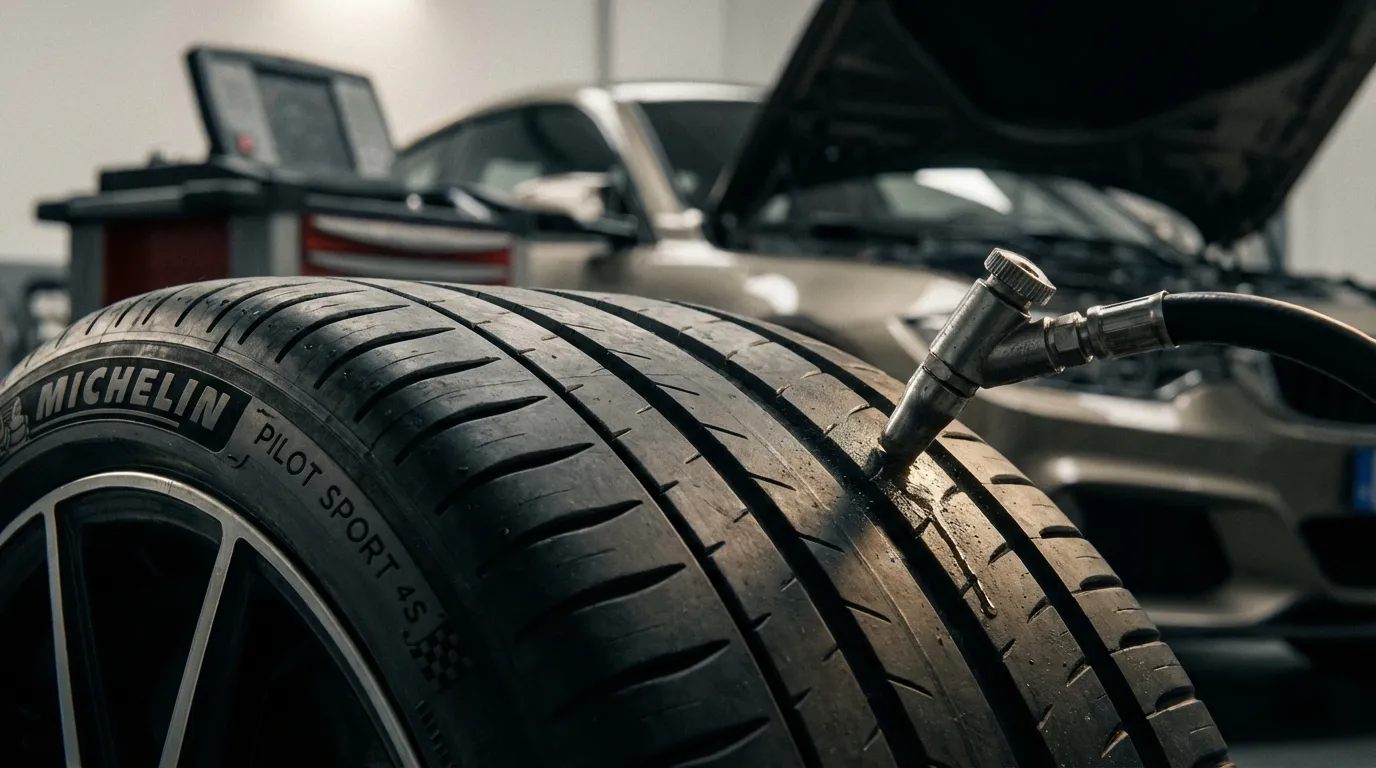
Why Inflating Your Tire to the Tire’s PSI Number is a Dangerous Mistake
When you look at the tire sidewall, you typically find something like: “Max load 615 kg – Max pressure 51 PSI.” Most drivers read this and think this is the ideal inflation value. However, this information is a trap for those who don’t understand the difference between Maximum Tire Pressure and Vehicle Recommended Pressure.
This number on the tire sidewall indicates the maximum limit that the tire safely supports under specific load conditions, not the value for daily use. In practical terms:
- Tire Pressure (Sidewall): This is the maximum the tire can handle; exceeding it puts you in a zone of risk for structural failure.
- Vehicle Recommended Pressure (Door Jamb/Manual): This is the value calculated by the vehicle’s engineering to balance safety, comfort, fuel economy, and braking performance.
This applies to everything from a small 1.0L hatchback to a modern hybrid SUV, like the KIA SELTOS 2027, which promises to change the game for compact SUVs. The tire is the same type of component, but the correct inflation depends on the weight, mass distribution, suspension, type of use, and even the vehicle’s design philosophy. (SEO/GEO Tip: Focus on “compact SUV tire pressure” or “KIA Seltos inflation guide” for specific US markets).
When you inflate to the tire’s “max PSI,” you are essentially telling your car: “Forget what the engineers calculated; I know better.” And almost always, this ends poorly.
What Happens to an Overinflated Tire in Practice
Putting too much air in a tire isn’t just about discomfort. It’s pure physics working against you in every pothole, curve, and braking event. Here are the main effects:
- Irregular and Premature Tread Wear
With too much pressure, the center of the tire “bulges” and becomes the area that contacts the ground the most. The result is:- The middle of the tread wears out much faster than the edges.
- You lose thousands of miles of tire life without realizing it.
- You will replace your set of tires much sooner than necessary, which is not cheap.
- Less Traction and Poorer Braking
Overinflated tires have a smaller contact patch with the asphalt. This means:- Less grip on wet surfaces, sand, packed dirt, and even good asphalt.
- Longer braking distances.
- A higher chance of the car “skidding” in mountain curves and sudden lane changes.
- Increased Risk of Blowout and Structural Failure
With excess pressure, the tire becomes stiff, less flexible, and vulnerable:- Impacts from potholes, uneven roads, and rocks are much more aggressive.
- The tire can develop bubbles, sidewall cuts, or even burst.
- A blowout at high speed is the perfect scenario for loss of control.
- Destroyed Comfort and Increased Suspension Impact
A tire that is too full functions almost like a solid wheel:- The car starts “bouncing” over irregularities.
- The suspension is constantly overloaded.
- Components like shocks, bump stops, and bushings wear out faster. This directly relates to the warning in the article about worn shocks being a deadly financial trap in your suspension.
In short: by trying to “correct” the PSI by copying the number on the tire sidewall, you create a combination of problems ranging from your wallet to your safety.
Where is the Correct PSI, and Why the Car Matters More Than the Tire
If the number on the tire isn’t ideal, where is the correct calibration? The answer is simple: on the vehicle, not on the tire.
The main places you find the recommended PSI are:
- Sticker on the driver’s door jamb (door open, interior side).
- Inside of the fuel filler door (some European and Japanese models).
- Owner’s manual.
- Electronic systems on newer model dashboards, in cars with TPMS (Tire Pressure Monitoring System).
These values consider real-world usage scenarios: empty car, full car, high speed, towing, luggage. Some manufacturers, especially for modern SUVs and crossovers, already list different pressures on the sticker for:
- Urban use with 2 occupants.
- Fully loaded car with luggage rack.
- High speed on the highway.
It’s the same engineering logic you see applied in other areas: for example, the precise calibration between torque and horsepower in vehicles designed for heavy towing, as shown in the test of the FORD SUPER DUTY and the brutal truth about horsepower vs. torque when towing. Nothing there is a guess; everything is fine-tuned calculation. It’s the same with tires. (SEO Tip: Use terms like “recommended tire pressure chart” or “vehicle load tire pressure”.)
Understanding What’s Behind the Recommended Pressure
When the manufacturer sets 32 PSI in the front and 30 PSI in the rear, for example, this decision took into account:
- Total vehicle weight and distribution between axles (front/rear).
- Type of suspension (MacPherson, multi-link, solid axle, etc.).
- Center of gravity (a low sedan does not behave like a 3-row SUV).
- Type of approved tire (size and load index).
- Balance between comfort, stability, and fuel economy.
If you ignore this and always inflate to the maximum close to the value on the tire, you will:
- Alter the car’s behavior in turns.
- Hinder the operation of all electronic controls (ABS, stability and traction control).
- Lose out on part of the designed safety features.
In sports cars or high-performance vehicles, like an Audi RS6 track-prepped or an extreme truck like the NISSAN FRONTIER PRO-4X R 2026, focused on heavy off-road use, the correct pressure is even more critical. Some manufacturers provide specific tables for track use, towing, or off-roading, but always with well-defined limits. Deviating from this is asking for the car to become a gamble.
When Adjusting PSI Makes Sense and How Not to Overdo It
There is a classic question: If the maximum on the tire is dangerous, should I always blindly follow the sticker? In 99% of cases, yes. But there are specific situations where adjustments make sense—and this is where many people get lost. (GEO Tip: Focus on regional driving conditions, e.g., “Off-road tire pressure adjustments in Texas” or “Highway load inflation for US drivers”).
Case 1: Heavily Loaded Car, Towing, or Long Trip
Traveling with a full car, packed trunk, possibly towing a trailer, jet-ski, or light trailer? Generally, manufacturers already include a specific column on the sticker with the calibration for maximum load.
- Increasing the pressure within the recommended range improves stability with extra weight.
- It reduces the risk of the tire overheating and deforming on a long trip.
- It helps keep fuel consumption more controlled.
But this doesn’t give you carte blanche to reach the maximum number stamped on the tire sidewall. Even under extreme use, you should not approach the “max PSI” unless the vehicle manual specifically indicates conditions that approach it, which is rare for common use cars.
Case 2: Light Off-Roading, Sand, and Trails
In off-roading, you often hear the opposite advice: “Lower the tire pressure, and the car handles better.” And, in this context, that makes sense under control:
- Slightly reducing the PSI increases the contact area with soft ground (sand, mud, dirt).
- It improves traction and prevents the vehicle from “digging in” so quickly.
But again, no guesswork. Those who take trailing seriously know there are recommended pressures for each surface type, precisely to avoid damage to the structure of the tire and wheel. Without this, the risk of the bead unseating (tire “coming off” the wheel) increases.
It’s the same logic of compromise seen in the development of vehicles that mix sporty intentions with off-road capability; just look at the radical balance Jeep achieved in extreme versions of the WRANGLER and how that raises questions about how much a more technological model can handle, a topic explored in the article about the JEEP RECON 2026 and its challenge to replace the Wrangler on tough trails. (SEO Tip: Keywords: “Off-road PSI adjustment,” “Beadlock risk.”)
Case 3: Blind Pursuit of Fuel Economy
One of the biggest gas station myths is: “Inflate a little extra, and the car will be more economical.” There is a kernel of truth—and an abyss of risk.
- More inflated tires slightly reduce rolling resistance.
- This can lead to a minimal gain in highway fuel consumption.
- But by exceeding the recommended value too much, you lose safety, grip, and comfort.
In practice, what matters is this: If you want to save on fuel, proper inflation maintenance, alignment, balancing, and quality spark plugs make a much bigger difference than “cramming in too much air.” It’s no coincidence that serious tests show the impact of components like advanced plugs on efficiency, a topic that appears, for example, in the discussion about Ruthenium vs. Iridium spark plugs and how they can save your engine and increase power. (SEO Tip: “Tire pressure fuel economy myth”).
How to Properly Inflate at Any Station
To get the right pressure without relying on luck or “attendant’s tips,” follow this simple step-by-step guide:
- 1. Check Your Car’s Sticker
Before you leave, open the driver’s door and check the recommended pressure for front and rear, for an empty and a full car. - 2. Inflate When Tires are Cold
The ideal is to inflate after the car has been stopped for at least 2 hours or driven about 2 miles (3 km) at low speed. Hot tires increase internal pressure, and you might be misled by the gauge reading. - 3. Adjust All Four Tires, Don’t Forget the Spare
There’s no point in having three correct tires and one completely wrong. A flat spare becomes useless when you need it most. - 4. Re-check After Major Load Changes
Returning from a trip with an empty car? Revert to the pressure recommended for normal use.
Consider this: the only point of contact between your vehicle and the ground is four areas of rubber barely larger than your palm. That’s the entire surface responsible for holding braking, turning, rain, potholes, and emergency maneuvers. Treating inflation as a minor detail is asking to end up in the wrong statistics. (SEO/GEO Focus: “Tire pressure maintenance schedule”).
In an era where we discuss absurd power, like hybrid twin-turbo V8s exceeding 900 hp and defying physics, or electric vehicles accelerating faster than supercars, maintaining correct tire pressure remains one of the simplest, cheapest, and most effective actions to protect your life, your wallet, and your car.
Next time the gas station’s air machine asks for the PSI, ignore the number written on the tire and check what truly matters: your vehicle manufacturer’s recommendation. That small difference between “maximum supported” and “ideal for driving” is what separates a safe, well-maintained vehicle from a mobile problem ready to blow out on the next curve.