
Have you ever wondered why diesel engines seem indestructible and consume less fuel on long trips? The answer lies in their extremely high compression ratio, which can reach 20:1 or more, compared to around 10:1 in gasoline engines. This difference is not coincidental: it’s pure chemical engineering!
What Is Compression Ratio and Why It Revolutionized Engines
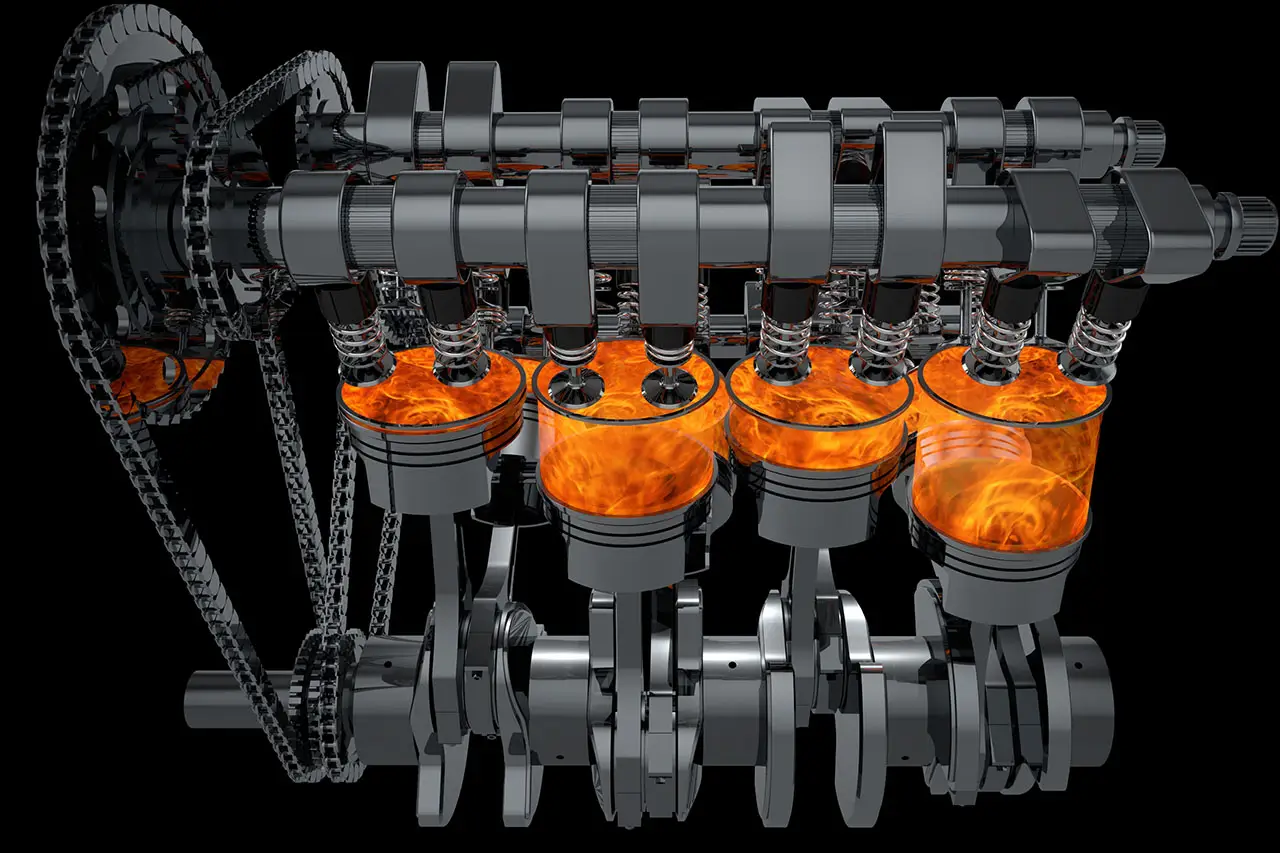
The compression ratio is the beating heart of any internal combustion engine. Imagine the cylinder as a giant syringe: it measures how much the volume of air (and fuel, in the case of gasoline) is reduced when the piston moves from bottom dead center (BDC) to top dead center (TDC). For example, a 15:1 ratio means 15 volumes of air are squeezed into just 1 volume. This pressure generates extreme heat – up to 600°C or more – essential for efficient combustion.
In gasoline engines, ratios typically range from 8:1 to 12:1 in common models, such as the Toyota Camry V6 or Honda Accord. But why? It all depends on the fuel. Gasoline is highly volatile: it evaporates quickly, has a low flash point (around -40°C), and auto-ignites at about 280°C (536°F). Compress it too much, and there’s a knock! Premature ignition or “pinging” damages pistons and connecting rods. That’s why high-performance sports cars, like some tuned Mazda Miatas, require premium 98-octane gasoline.
On the other hand, diesel is the opposite: denser, less volatile, evaporates slowly, and auto-ignites at about 210°C (410°F). It requires intense compression to heat the air enough to ignite itself, without a spark plug. Result? Ratios of 14:1 to 25:1, as seen in the Ram Power Wagon’s Cummins diesel, which delivers enormous torque for heavy off-road use.
| Feature | Diesel Engine | Gasoline Engine |
|---|---|---|
| Typical Compression Ratio | 14:1 to 25:1 | 8:1 to 12:1 |
| Ignition Type | Compression Ignition | Spark Ignition |
| Auto-ignition Temperature (°C) | ~210°C | ~280°C |
| Thermal Efficiency | 35-45% | 25-35% |
This table summarizes the key difference: diesel engines are more efficient because they extract more energy from fuel. A modern diesel engine can convert up to 45% of chemical energy into useful power, compared to around 35% for gasoline engines. It’s basic thermodynamics—more compression equals higher temperature, leading to more explosive combustion.
Fuel Chemistry: Why Diesel Supports Extreme Compression
Gasoline is a lightweight mixture of hydrocarbons C4 to C12, designed to vaporize instantly in the intake manifold. It forms a fine mist that ignites precisely with the spark plug. Under high pressure, however, molecules can stir and auto-ignite prematurely—hence the importance of the octane rating, which delays this undesirable reaction.
Diesel, composed of C10 to C20 hydrocarbons, is injected directly into the already compressed cylinder. The hot air (ranging from 500-700°C) vaporizes the diesel jet, which then burns progressively. No spark plug needed! This is the principle of the Diesel cycle, invented by Rudolf Diesel in 1892, which prioritizes efficiency over ignition speed.
“Compression isn’t just brute force: it’s the key to burning diesel more completely, reducing emissions and saving fuel on long trips.” – Bosch engineers.
Impressive exceptions? The Mazda Skyactiv-G achieves 14:1 compression ratio in regular gasoline (87 octane) thanks to concave pistons and dual injection, avoiding knocking. In comparison, a diesel engine can reach about 20% better fuel efficiency. Another example is engines with dual ignition, which burn gasoline more cleanly, approaching diesel efficiency.
And what about errors? Putting diesel in a gasoline engine causes clogging and failure—or vice versa, inefficient combustion. Learn what happens and how to prevent costly damages.
Real-World Examples: From Pickup Trucks to Supercars
In practice, consider the RAM’s Cummins 6.7L: 24:1 compression ratio, 420 hp, and torque capable of towing 15 tons. Its efficiency? Averaging around 12 km/l on the highway. Compare that with a V8 gasoline Hemi: 10:1 compression ratio, more high-end power but less economical in city driving.
In supercars, rare diesel engines like the Audi R10 TDI from Le Mans used a 17:1 compression ratio to dominate endurance races. Today, hybrids like the Lamborghini Tempesto combine turbocharging with high compression but still retain gasoline technology.
- Diesel Advantages: Lower fuel consumption (denser fuel: 38 MJ/l vs 32 MJ/l for gasoline), immediate low-end torque, durability (often surpassing 500,000 km).
- Disadvantages: Vibration, noise, NOx emissions (mitigated with AdBlue).
- Gasoline Advantages: Smoother operation, higher RPM capability, lower initial purchase cost.
Today, turbochargers and common-rail injection systems have pushed diesel technology to incredible levels: the Mercedes OM654 engine achieves a 16:1 compression ratio with 190 hp/liter. Its thermal efficiency approaches 50% in laboratory tests. Looking ahead, diesel hybrid-electric systems promise to bridge the gap even further.
In summary, high compression in diesel engines isn’t a luxury—it’s a chemical necessity for spontaneous ignition and maximum efficiency. Next time you drive a Ram Cummins or VW TDI pickup, feel the torque—that’s compression working. Curious for more? Follow automotive news on the Car Channel and debunk myths that cost you at the pump!