
You brake at the traffic light, hear a high-pitched screech like nails on a chalkboard, and the workshop warns: “Replace all four pads!”. But is this really necessary on your TOYOTA CAMRY or just a way to inflate the bill?
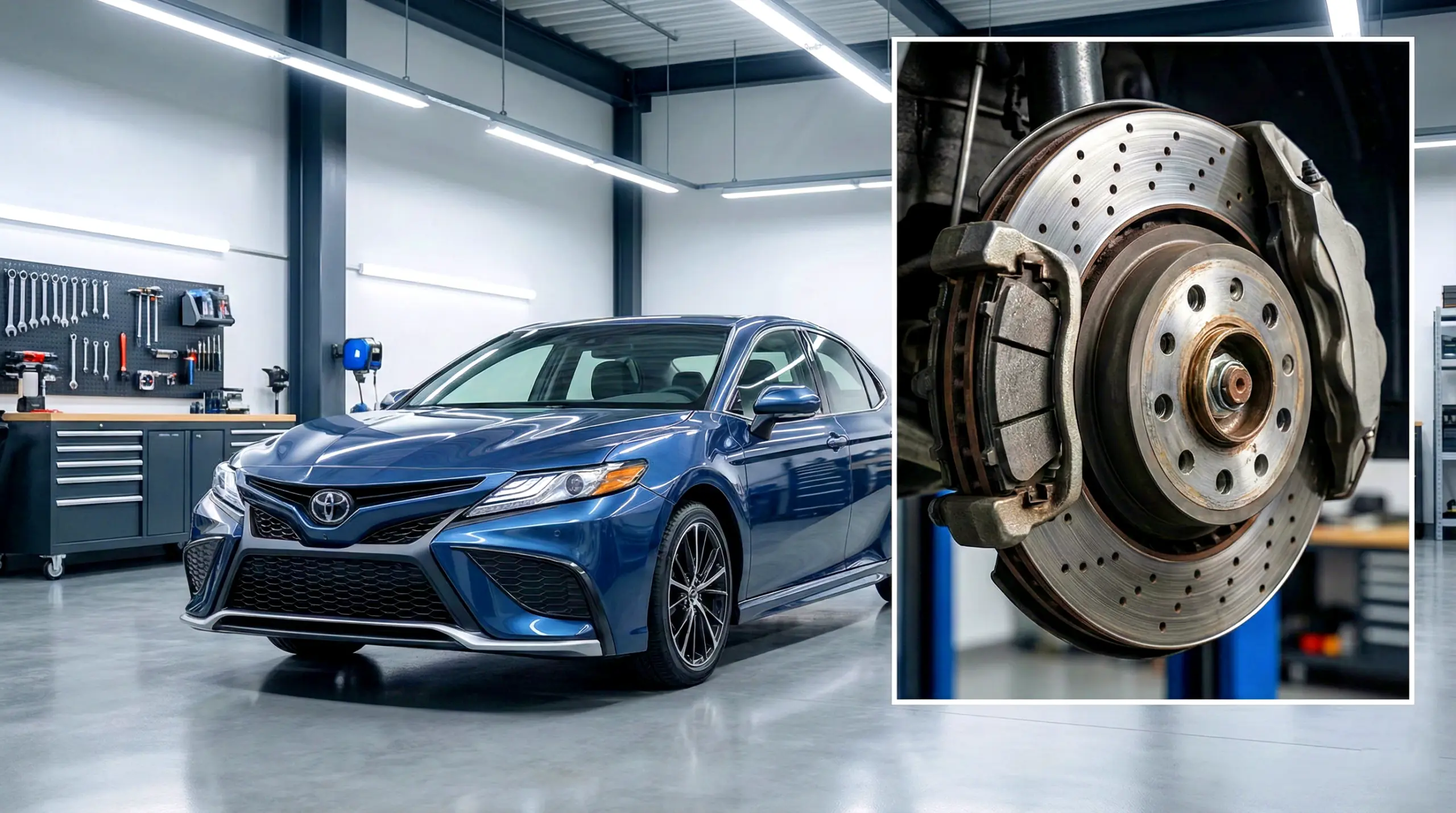
How to Identify When Your Car’s Brake Pads Are Worn Out
Before deciding how many pads to replace, understand the warning signs your car emits. Disc brakes, standard in models like the TOYOTA CAMRY, use pads that press against the rotating discs to generate friction and stop. Over time, this friction material wears down, and ignoring this can turn a simple pad replacement into an expensive nightmare.
The first indicator is noise: a sharp squeal when braking indicates that the metal wear indicator is rubbing against the disc. If it progresses to a loud screech, metal is contacting metal – time to panic. Other symptoms include soft or vibrating pedal, longer braking distances than usual, and warning lights on the dashboard. In the TOYOTA CAMRY, with its reliable brake system, these signs typically appear between 40,000 and 70,000 miles (or 65,000 to 110,000 km), depending on driving style: urban traffic accelerates wear, while highways prolong it. Ideal for US driving conditions.
- 3 mm rule: Measure the thickness of the pad. Below 3 mm of friction material, replace immediately.
- 80% lifespan: Experienced workshops follow this metric – when only 20% remains, replace to avoid damaging the discs.
- Vibration on the steering wheel: Suggests warped discs due to excessively worn pads.
Driving with bad pads is not just noisy: it causes overheating, reducing efficiency and increasing risks in emergencies. Insurance studies show that brake failures cause up to 30% of preventable accidents. For the TOYOTA CAMRY V6, common across North America, debunk urban legends about maintenance and focus on the essentials: visual inspection every 6,000 miles (or 10,000 km).
| Pad Type | Average Durability (Miles) | Recommended For |
|---|---|---|
| Organic | 18,000 – 25,000 | Gentle daily use |
| Semi-metallic | 25,000 – 37,000 | Balanced performance |
| Ceramic | 30,000 – 43,000 | Low noise, premium like in the CAMRY |
These numbers vary with habits: aggressive driving in metropolitan areas cuts lifespan in half. Always prioritize original parts or certified brands to maintain the warranty of the TOYOTA CAMRY.
Why Do Workshops Insist on Replacing All Four Pads? Advantages and Myths
Many drivers ask:
“Why not just replace the worn ones?”
The answer lies in balance. Imbalanced brakes cause pulls to one side, instability, and uneven wear. In the TOYOTA CAMRY, the front pads wear 60-70% faster due to weight transfer during braking – the fronts do most of the work. This applies universally to front-engine vehicles.
Recommending all four ensures uniform performance: equal hydraulic pressure in all corners, preventing new pads from “pulling” the old ones and accelerating wear. Economically, it makes sense: labor is the biggest cost (estimated $150-$300 per axle in the US). Replacing everything at once is cheaper in the long run, avoiding repeated visits. For SUVs or sedans like the CAMRY, this preserves the discs, which cost $300-$700 each to machine or replace.
But it’s a myth that it is always mandatory. Experienced mechanics say: if the rear pads have more than 50% of their life left, just replace the front ones. The key is respecting the axle – never replace only one pad per wheel, as it creates asymmetric braking and accident risks. In preventive maintenance like spark plugs or brakes, balance is king.
Compared to truck drum brakes, the discs of the CAMRY are more efficient but require perfect synchronization. Actual US costs: front pads $150-$350 (pair), rear $100-$300. Total for four: $400-$1,000, including professional alignment check.
When Replacing Only Two Pads Is Safe and Financially Reasonable
Don’t fall into overkill: if inspection shows the rears are in good condition, opt for the minimum required. In the TOYOTA CAMRY, common in corporate fleets, this saves up to 50% without compromising safety. Conditions for this:
- Fronts below 3 mm, rears above 5 mm.
- No vibrations or warning lights.
- Mixed driving (city/highway), not off-road.
DIY or workshop step-by-step:
- Lift the car and remove wheels.
- Measure thickness with a caliper.
- Use a torque wrench for bolts (specific for CAMRY: 80 Nm or 59 ft-lbs).
- Bleed the system to remove air.
- Test in a safe place.
For hybrids or electric vehicles increasingly common in the US, such as those seen in EV myths, regenerative brakes reduce wear on the front pads – another reason to check each axle. Avoid common mistakes: wrong pads cause noise or fading. Opt for ceramics for silence in chaotic traffic. Ceramic pads are highly popular in US markets for their quiet operation.
Regular maintenance prevents disasters. In the TOYOTA CAMRY, integrate it into the annual plan: oil, filters, and brakes. If you experience engine problems like excess oil, bad brakes worsen everything. Safety first: brakes fail, lives are lost. Inspect today and drive safely tomorrow.
With these tips, you save money, maintain performance, and avoid workshop pitfalls. Your TOYOTA CAMRY thanks you – and so does your family.