
TESLA MODEL Y faces a rigorous efficiency test. See how saving time can destroy your road-trip range.
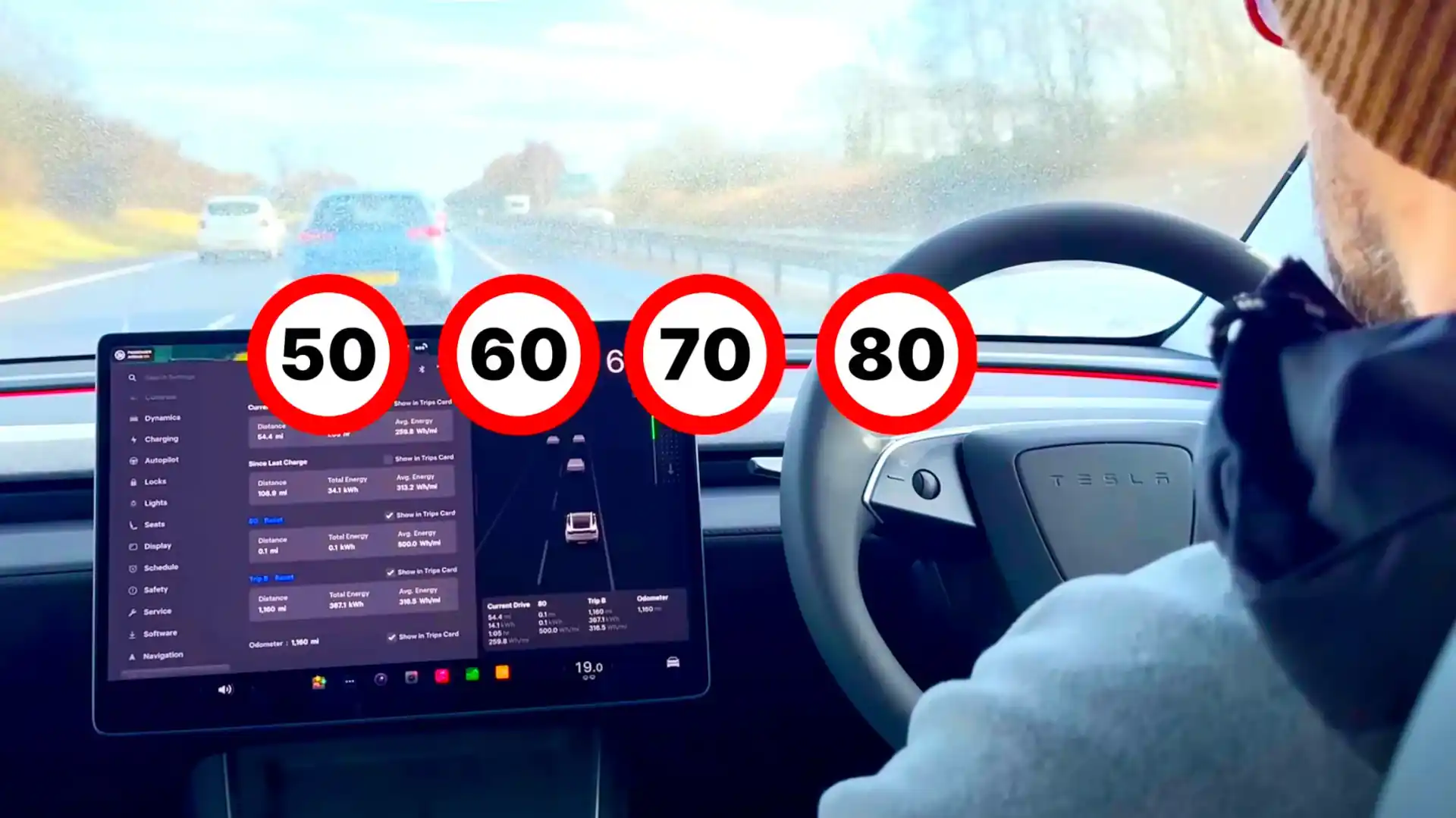
In an electric car, driving faster does not just cost energy. It costs real-world range, safety margin, and on long trips, it can even steal back the time that seemed to have been gained. A practical test with the Tesla Model Y put this dilemma under the microscope and showed that there is, in fact, a much smarter speed range for anyone driving on the highway.
What Happens To An Electric Car’s Range When Speed Increases
Anyone who drives a combustion car already knows that going faster increases consumption. In the EV world, this effect becomes even more obvious because of aerodynamics. At higher speeds, air resistance grows disproportionately, requiring much more battery energy to maintain the same pace.
In the case analyzed, a Tesla Model Y rear-wheel drive repeated the same highway route at four constant speeds. The goal was simple and extremely relevant for anyone researching electric car range, highway consumption, and best speed for EV.
Based on the efficiency data measured in Wh/mi and an estimated usable capacity of 75 kWh, it was possible to project the electric SUV’s real-world range in highway use. The result helps answer a question that is increasingly common among Brazilian and foreign drivers considering switching to electrification.
Dilemma summary
Driving faster reduces the immediate time of the trip, but it can also force an extra charge. And that stop, depending on the available infrastructure, wipes out all the advantage gained by pressing the accelerator.
This topic becomes even more important in a market racing to improve batteries and ultra-fast charging. Not by chance, advances like those shown in BYD Blade Battery 2nd Generation and the 400 km in 5 minutes leap show why the range war is still far from over.
The TESLA MODEL Y Test Shows Where the Real Sweet Spot Is
At a steady pace of 50 mph, roughly 80 km/h, the Model Y delivered excellent energy efficiency. At 80 mph, around 129 km/h, the situation changed drastically. The travel time dropped, but the range also plunged.
| Speed | Estimated time over 322 km | Efficiency | Calculated range |
|---|---|---|---|
| 80 km/h | 4h00 | 224.7 Wh/mi | 536 km |
| 96 km/h | 3h20 | 249.9 Wh/mi | 483 km |
| 113 km/h | 2h51 | 302.2 Wh/mi | 399 km |
| 129 km/h | 2h30 | 366.2 Wh/mi | 328 km |
In practice, the numbers reveal something decisive. Going from 80 km/h to 129 km/h cuts travel time by about 38%, but reduces range by a similar proportion. In other words, the gain in speed comes at a brutal cost.
The most rational balance point seems to be between 96 km/h and 113 km/h. In that range, the driver still cuts travel time significantly without excessively compromising range. On medium-distance trips, this is the speed that tends to deliver the best cost-benefit balance between haste and efficiency.
For those following the industry, this kind of result also helps explain why new EV projects insist so much on aerodynamics, thermal management, and charge prediction software. It’s the same reasoning that appears in ambitious proposals like the BMW iX 2026 and the discussion about real-world range, where small usage adjustments can completely change the road-trip experience.
Why Driving Slower Can Make You Arrive Earlier
This is the most interesting paradox of the test. Over a stretch of about 322 km, the car can actually complete the trip at very high speed without necessarily stopping. But the final battery margin gets tight. And in the real world, headwinds, hills, heavy air conditioning, outside temperature, and traffic can wreck the calculation.
If the driver needs to recharge for 15 or 20 minutes, all the supposed gains from driving faster disappear. In some scenarios, driving a little slower makes the car use less energy, avoids the stop, and reduces the total door-to-door time.
- Too low a speed greatly increases travel time
- Too high a speed destroys efficiency and raises the risk of an extra charge
- Middle range delivers the best balance between range, time, and peace of mind
Another important detail is that this behavior is not exclusive to Tesla. Virtually every electric SUV suffers from the combination of high weight and a larger frontal area, two factors that amplify the impact of the air at cruising speed. This helps explain why new-generation models are betting so heavily on dedicated platforms, higher voltage, and more advanced batteries, as seen in recent plays like the Chevrolet Bolt 2027 and the Nissan Leaf 2027.
It’s also worth remembering that efficiency doesn’t depend only on the battery. Tires, temperature, carried weight, tire pressure, and even the design of the mechanical assembly all influence the result. If you want to understand how seemingly small components transform comfort, response, and consumption, it’s worth seeing the hidden component that decides between comfort, durability, and brutal response.
Practical verdict: for most EV drivers on the highway, keeping something around 100 km/h to 110 km/h tends to be the smartest choice. It’s fast enough not to make the trip tiring, efficient enough to preserve range, and safe enough to avoid that anxiety of watching the battery percentage drop too quickly.
In the end, the test leaves a valuable lesson. In an electric car, the ideal speed is not the maximum the vehicle can handle, nor the minimum that saves everything. It’s the one that delivers the best balance between real travel time, consumption, and peace of mind. And that sweet spot is almost always well before your foot is planted on the floor.