
Still driving in neutral to save? Discover why coasting in neutral consumes more fuel, destroys your brakes, and puts your life at imminent risk.
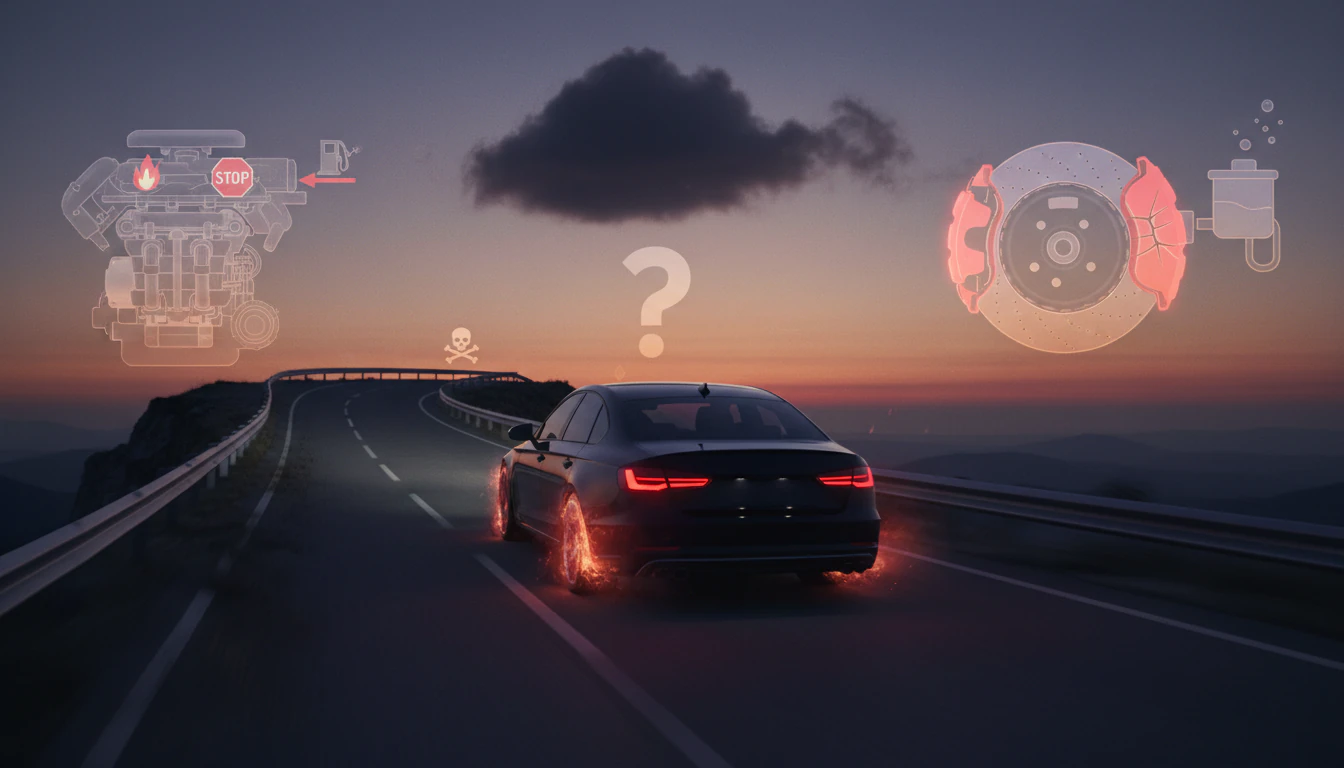
Whenever gas prices spike at the pumps, a wave of internet “experts” and bar conversations resurrect old tricks to try to extend the tank’s range. If you often drive on roads with steep inclines or mountain passes, you must have felt the temptation: the engine screams uphill, devouring fuel, and downhill, gravity seems to be your best friend. It’s at this moment that many drivers make a foolish mistake inherited from the carburetor era: placing the gear in neutral, the famous “coasting in neutral” (or banguela in Portuguese). If you do this thinking you’re being smart or economical, stop now. You’re not only mistaken about the savings but turning your vehicle into a high-speed mechanical trap.
The Myth of Economy: Why Electronic Injection Changed Everything
The idea that coasting in neutral saves fuel is perhaps the most persistent and harmful automotive myth today. The logic seems simple to a layperson: if the engine RPM drops to idle (about 800 to 1,000 rpm), fuel consumption should be lower than if the engine were running at 3,000 rpm engaged. Wrong.
This logic worked in old carbureted cars, where airflow mechanically pulled fuel. However, in any modern vehicle equipped with electronic fuel injection—that is, practically any car manufactured in the last three decades—the system is controlled by an ECU (Engine Control Unit). Your car’s computer is smarter than you think.
When you descend a hill with the gear engaged and take your foot off the accelerator, the system enters a mode called Fuel Cut-Off. The injection completely cuts off fuel supply. The inertia of the wheels, connected to the engine through the transmission, keeps the pistons moving. Fuel consumption in this situation is literally zero.
On the other hand, putting the gear in neutral disconnects the wheels from the engine. To prevent the engine from stalling, the ECU must inject fuel constantly to maintain idle. That is, in an attempt to save fuel, you are actively burning gasoline that wouldn’t need to be burned. To better understand how engineering has evolved and how these decisions affect durability, it’s worth knowing the brutal truth about automotive engines and the material war that shapes your vehicle’s efficiency today.
The Invisible Danger: Brake Overheating and Catastrophic Failure
Besides affecting your wallet, the practice of coasting in neutral is a roulette with safety. Engine braking—the natural resistance the engine offers when the gear is engaged and the accelerator is released—is a key component of the vehicle’s braking system, especially on long descents.
When you put the car in neutral, you eliminate 100% of this assistance. The only thing preventing your car from uncontrollably accelerating downhill are the brake pads and discs. Relying solely on the hydraulic system to control speed on a descent causes excessive heat buildup.
The “Brake Fade” Phenomenon
Extreme heating leads to what engineers call Brake Fade. Brake fluid can boil, creating air bubbles in the lines, making the pedal spongy and ineffective. Additionally, brake pads can vitrify, losing the necessary friction to stop the car. Suddenly, you press the brake and… nothing happens.
This is not just an accident risk; it’s an unnecessary and accelerated wear risk. Often, drivers are led to believe they need costly corrective maintenance for “misuse,” when in fact it’s just a bad driving habit. It’s the same misinformation that makes people doubt whether they should replace all four brake pads or if it’s an exaggeration by workshops, when technically it depends on the driver’s behavior and the vehicle.
Loss of Control and Hidden Mechanical Risks
The active safety of a vehicle depends on traction. A car in neutral is a “loose” car. If you need to make an emergency evasive maneuver—to dodge a pothole, an animal, or another vehicle that braked suddenly—the lack of connection between the engine and wheels can be fatal.
Without engaged traction, steering response can be less precise in high-speed turns. Also, you lose the ability to accelerate instantly to escape a dangerous situation. The time it takes to re-engage the gear, whether in a manual or automatic, can be the difference between a scare and a serious collision.
Another critical point is the assistance system. If, for any reason, the engine stalls while coasting in neutral (which can occur due to idle issues or electrical problems), you will lose brake assistance (vacuum) and power steering—whether hydraulic or electric—will become extremely heavy. Trying to control a 3,300-pound car downhill without assisted brakes and with the steering locked is a recipe for disaster.
“The illusion of control when coasting in neutral disappears in the first second of a real emergency. Physics doesn’t forgive.”
The stability of your car depends not only on the brakes or the engine but on the entire suspension system working in harmony. Ignoring vehicle dynamics is as dangerous as falling into the financial and deadly trap of worn shocks, which is often neglected until it’s too late.
Damage to Transmission and Internal Components
If safety is not enough, let’s talk about mechanics. In manual cars, the habit of resting your foot on the clutch or constantly disengaging it on descents causes premature wear on the clutch release bearing. It’s a cheap part but requires complete gearbox removal to replace, resulting in very high labor costs.
In modern automatic transmissions, the situation can be even more complex. Although many have protection systems, repeatedly shifting between “D” (Drive) and “N” (Neutral) with the vehicle moving can cause unnecessary stress on internal bands and clutches. In some models, it can also reduce internal lubrication efficiency, which depends on input shaft rotation connected to the engine.
Preventive maintenance is always cheaper than corrective. Falling for driving myths is as damaging to your wallet as falling for counterfeit parts. It’s a scenario similar to the invisible scam of fake spark plugs that can melt your engine; ignorance about technical functioning is costly.
Legal Aspects and Technology Against You
In the United States, several states explicitly ban coasting in neutral. In Brazil, although visual enforcement is difficult, the Brazilian Traffic Code (CTB) establishes a medium infraction for operating a vehicle with the engine off or disengaged on a slope (Art. 231, IX). The fine exists precisely because of the risks this behavior poses to others on the road.
And don’t think you are immune to detection in case of a serious accident. Modern cars are equipped with modules that function as “black boxes” (EDR – Event Data Recorder). In a forensic investigation after an accident, these data can reveal that the gear was in neutral at the moment of impact, which can transfer civil and criminal liability to you and give insurers grounds to deny coverage.
Automotive technology progresses to correct human error. Today, intelligent systems already manage traffic and efficiency so that drivers don’t need to resort to “hack” driving. We are already seeing innovations where GPS makes traffic lights intelligent and reduces your time lost in traffic, proving that efficiency comes from integrated technology, not from putting the car in neutral.
Therefore, keep the car engaged. You save fuel, preserve your brakes, maintain full control of the vehicle, and avoid legal problems. Coasting in neutral is a relic of the past that has no place on modern roads.