
Discover how engineering crafted the LFA’s symphony and why this mechanical era will leave an everlasting longing.
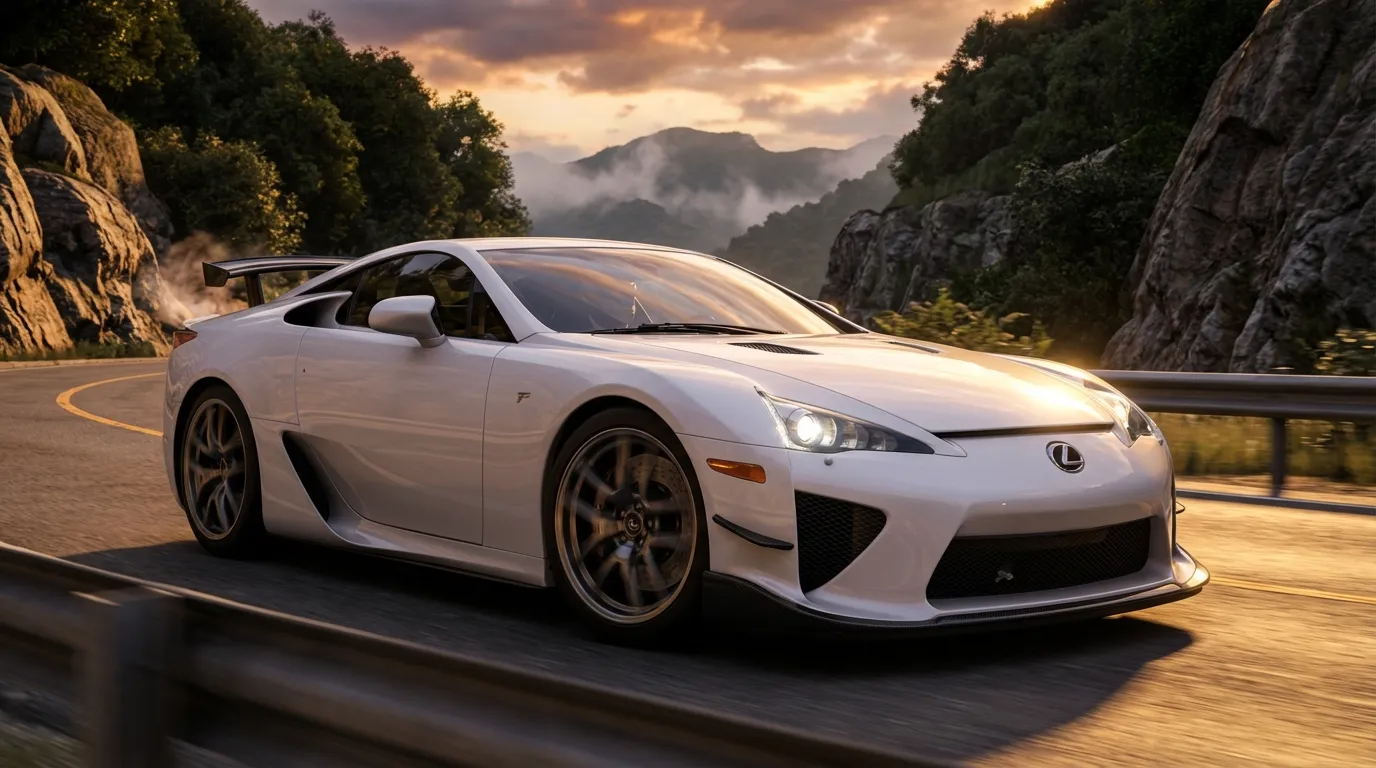
The Fascination with V10 Engines: Power, Sound, and the Perfect Balance?
10-cylinder engines, especially V10s, represent the pinnacle of classic automotive engineering, featured in icons like the LEXUS LFA and the DODGE VIPER. But does this sonic glory compensate for technical pitfalls? Let’s dive into the pros and cons that define why these powerplants shone—and disappeared—from our streets.
Pros of V10s: The Goldilocks Zone of Power and Smoothness
V10 engines occupy a privileged position between V8s and V12s, the so-called “Goldilocks zone”—neither too large nor too small. With more cylinders than a V8, they deliver superior power and operate at higher revs. Smaller pistons and reduced reciprocating masses allow spins exceeding 9,000 rpm in some instances, such as in 1990s and 2000s Formula 1, where they dominated for nearly a decade.
The sound is the biggest selling point: scientific analyses, like those by engineer Scott Mansell, reveal that V10s accentuate harmonic frequencies, creating musical intervals that are “wider” and sound more pleasing to the human ear. The LEXUS LFA, with assistance from Yamaha (yes, the same company that makes pianos), elevated this to an art form, featuring an exhaust tuned to echo like a high-performance violin. Compared to a V12, the V10 is more compact, theoretically consumes less fuel (due to less friction and rotational mass), and responds more quickly—ideal for sports cars.
- High Power and Revs: Brutal acceleration with power strokes occurring every 72 degrees in even-fired configurations.
- Relative Smoothness: Good primary and secondary balance, surpassing V8s in refinement.
- Versatility: Used from supercars to heavy-duty trucks like the Ford Triton 6.8L, proving efficiency under heavy loads.
This combination made the V10 a golden choice for premium manufacturers, offering excitement without the excess bulk of a V12.
Cons of V10s: Vibrations, Size, and the Farewell to the Analog Era
However, paradise has its drawbacks. V10s suffer from rocking couples—lateral vibrations caused by the 72-degree “V” layout in even-fired builds, necessitating massive balance shafts, as seen in the Ford Triton. Odd-fired designs, common at 90 degrees like in the DODGE VIPER, alternate between 54 and 90-degree intervals, generating irregularities that require counterweights or additional dampers.
| V10 vs. Alternatives Comparison | V10 | Turbo/Hybrid V8 | V12 |
|---|---|---|---|
| Size/Complexity | Medium-High | Low | High |
| Fuel Consumption | High | Low-Medium | Very High |
| Smoothness | Good (with assists) | Excellent (hybrid) | Perfection |
| Maintenance Cost | High | Low | Very High |
More complex and thirstier than turbocharged V8s, V10s lost ground to downsizing and electrification. Today, LAMBORGHINI TEMERARIO retired the V10 for a twin-turbo hybrid V8 producing 907 hp, prioritizing EPA efficiency and emissions standards. Automakers now favor turbo + hybrid setups for higher torque with less weight, similar to how turbo 4-cylinder engines surpassed V6s and V8s in road applications.
Examples like the VW Touareg V10 TDI demonstrated diesel potential, but notorious complexity ultimately doomed them. In the end, vibration, size, and cost sealed their fate: rare in current production, but eternal in classic status.
V10s serve as a reminder of the raw essence of mechanics—a visceral power that turbos and batteries have yet to replicate. If you dream of that growl, seek out a used LFA or Viper, but be prepared for the expense. The hybrid era is progressing, but the legacy of the 10-cylinder engine echoes forever.