
The “100% electric future” is still coming, but not at the speed many swore it would: A new market snapshot shows more buyers abandoning EVs and returning to gasoline cars, a move that could redefine prices, supply, and even what automakers manufacture in the coming years.
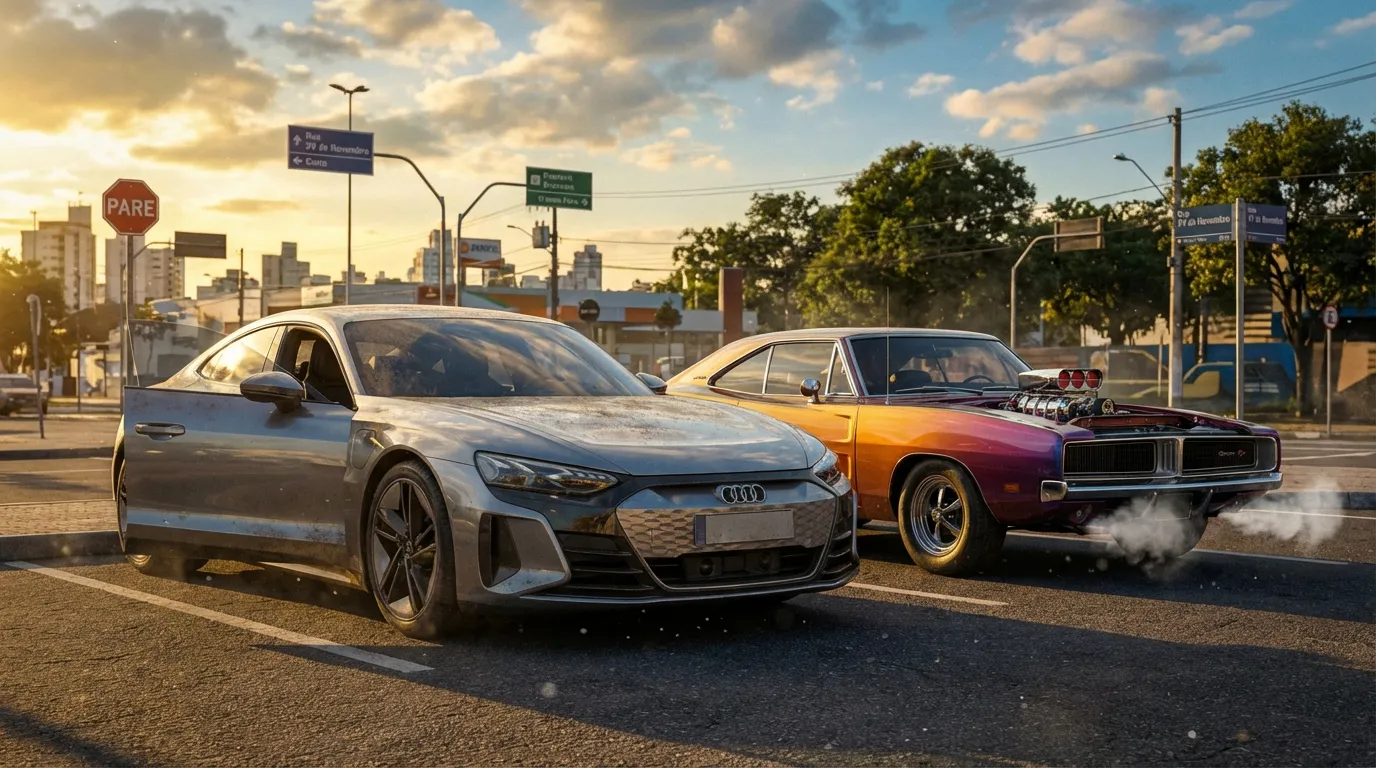
The Rebound Effect: Why Gasoline Is Once Again Looking Like The “Safe” Choice
In recent years, the electric car became synonymous with modernity, efficiency, and environmental consciousness. However, in the real world, buying a car is rarely guided purely by ideals. It is guided by perceived risk: “Will I be able to use it?”, “Will I be able to resell it?”, “Will I get stranded?”, “How much will this really cost?”. And that is where the market sentiment began to shift.
A recent international survey by EY (Ernst & Young), cited by outlets like Reuters, indicates a clear turnaround in purchase intention: about half of consumers planning to buy a new or used car in the next 24 months say they want an internal combustion engine (ICE) model. This number has significantly increased compared to the previous year, while the intention to buy battery electric vehicles (BEVs) has retreated to a minority level. The preference for hybrids also lost traction during the same period.
Translated for the average driver: enthusiasm exists, but the final decision is becoming more conservative. Instead of “being a pioneer,” many people prefer “not being a guinea pig.”
Keywords explaining this behavior (and dominating searches): electric car price, real-world range, charging infrastructure, depreciation, battery cost, and resale value.
This movement is not just emotional. It is fueled by three objective forces:
- Public policies changing mid-stream: When regulations and incentives fluctuate, the consumer feels instability.
- Tight economy and expensive credit: If financing weighs heavily, the buyer tends to stick to the “known path.”
- Real use vs. promise: The urban driver might love an EV, but those who frequently travel long distances, live in buildings without charging access, or depend on the car for work calculate differently.
For those who appreciate mechanics and durability, there is also a silent factor: the perception (correct or not) that the ICE engine is “repairable on any corner,” whereas the electric car seems to depend on an authorized network, expensive parts, and component availability. Interestingly, this reasoning coexists with the reality that many ICE car problems stem from neglected maintenance. If you want to see how simple mistakes turn into big losses, it’s worth reading Maintenance Mistakes That Are Making Your Mechanic Rich And Putting Your Safety At Risk.
What Is Slowing Down EVs And Hybrids: The 7 Pain Points Buyers Won’t Forgive
When the market slows down, it is not because people “hate technology.” It is because the complete package is not yet viable for many. Below are the main reasons that frequently appear in sector analyses, dealership conversations, and search behavior.
1) Total Price: The “Monthly Cost” Became The Final Judge
Even with price drops in some markets, the electric vehicle is often still more expensive at the entry point. And the average buyer doesn’t buy a “car”; they buy a monthly payment. If the EV installment exceeds the psychological limit, the sale dies right there.
2) Charging: It’s Not Just Having a Charger, It’s Having a Charger At The Right Time
The charger map has grown, but the problem is predictability: queues, out-of-service chargers, lower-than-advertised power, different apps. For those who drive long distances frequently, the feeling of “dependence” weighs more than the benefit of cheap kWh.
3) Real-World Range: The World Is Not A Laboratory
Air conditioning, heavy traffic, highway speeds, hills, and ambient temperature change everything. When the buyer realizes that the “catalog” range is not the range of their daily life, the famous range anxiety is born.
4) Depreciation And Resale: The Fear Of The “Old Cell Phone” On Wheels
A segment of the public views the EV as consumer electronics: every two years, a better battery, faster charging, or greater range comes out. This creates apprehension about buying today and losing value tomorrow. And, in several markets, the depreciation of some EVs has genuinely become news.
5) Geopolitics And Supply Chain: The Buyer Is More “Savvy”
The cited study points out that a significant portion of EV interested parties are reconsidering or postponing their purchase due to geopolitical events. This connects to a simple fear: “Will parts run out?”, “Will batteries run out?”, “Will prices increase?”
6) Hybrids Are Also Feeling The Pressure
The hybrid is often seen as the perfect middle ground: no plug (or plug-in capability for PHEVs), lower consumption, and less risk. But it can also suffer from high prices, more complex maintenance, and doubts about which technology will “win.” Even so, some hybrids have created a different proposition: driving like an electric without needing to plug in. To understand why this is gaining ground, see NISSAN QASHQAI E-POWER 2025: The Hybrid SUV That Drives Like an Electric Without Plugging In.
7) The Buyer Discovered That “Cheap Maintenance” Depends On How You Care For It
With internal combustion cars, there is a chasm between a well-maintained car and a poorly maintained one. In many cases, noises, failures, and recurring costs stem from neglect, not the car’s design. A classic example: wrong decisions regarding simple components can trigger a cascade of defects. If you enjoy the technical side, understand why some engines use solutions to reduce noise and wear in Hydraulic Lifters: Why Some Engines Use This Technology And How It Makes Your Car Quieter.
What This Means For Automakers
When consumer intent shifts, the industry responds not with speeches, but with product, inventory, and factory output. And this is where the topic gets interesting, because we are not just talking about “public taste,” but a global strategy realignment.
In the United States, regulatory decisions that are more favorable to combustion engines may reduce the pressure to electrify at any cost and open space for more gasoline and, especially, “simpler” hybrid models. This influences the production mix and may affect what reaches other markets.
In Europe, the debate about easing targets (including room for combustion engines running on synthetic fuels and hybrids after 2035) sends a strong signal: the path may be less linear than imagined. For the industry, this is almost an invitation to keep ICE platforms alive longer.
And in Brazil? Brazil lives its own reality, governed by three variables: price, infrastructure, and usage profile. Here, the transition tends to be “by island”: electric vehicles grow more where infrastructure and income allow; hybrids and flex-fuel gain relevance as a bridge; and combustion remains dominant due to scale and entry cost.
Furthermore, the Brazilian consumer has a very pragmatic behavior: they accept novelty, but demand that it functions in traffic, on the road, and for maintenance. And there is a little-discussed detail: many drivers do not have a garage with a power outlet, making home charging unfeasible for a huge portion of the urban fleet.
For those about to buy, the scenario becomes a timing game. The question is not “Is EV good or bad,” but rather: which technology fits your usage and your budget right now?
| Usage Profile | What Usually Makes Most Sense | Main Risk |
|---|---|---|
| City, fixed routes, garage with charging | Battery Electric Vehicle (BEV) | Depreciation and charging network on trips |
| City + occasional highway travel | Hybrid (HEV) or PHEV | Purchase price and complexity |
| Frequent highway travel, rural areas, limited infrastructure | Combustion (Flex/Gasoline/Diesel) | Fuel cost and neglected maintenance |
One point almost nobody puts at the center of the conversation: the internal combustion engine is still evolving. There are improvements in efficiency, emissions, durability, and noise. Many of these are invisible to those who only follow the “technology war,” but they make a difference in daily life.
If you want a rawer look at what lies behind modern engines (and why some last longer than others), dive into AUTOMOTIVE ENGINES: The Brutal Truth About The War Between Cast Iron And Aluminum That Changed Your Car. This kind of technical detail helps explain why many people still trust what they know.
At the same time, it is a mistake to think that “electric is over.” The market is adjusting, not giving up. There are strong signs of continuity: new models with greater range, faster charging, batteries with less degradation, and software improvements. Moreover, one of the most repeated myths about EVs is starting to crumble: the idea that the “battery will fail quickly.” Data from studies and fleets indicate a low replacement rate in many usage scenarios.
The likely result for the coming years is a market more hybrid in the literal sense: more options, less single-narrative discourse. Instead of a straight race toward 100% electric, the world may be entering a phase of “multi-propulsion”: more efficient combustion, hybrids with different architectures, and electric vehicles growing where infrastructure allows.
“The transition to electric vehicles is not an on/off switch. It is a continuous negotiation between price, infrastructure, policy, and consumer trust.”
For the buyer, this creates an advantage: when automakers compete over which technology delivers the most value per dollar, you gain the power of choice. And right now, that power is causing many to return to gasoline not out of nostalgia, but out of calculation.