
If your engine has started making that metallic “tick-tick” sound at idle and you thought, “that’s it, here comes an expensive repair,” you’re not alone. The difference between a smooth, quiet engine and a noisy one full of clicking often lies in a small, ingenious part: the hydraulic lifter.
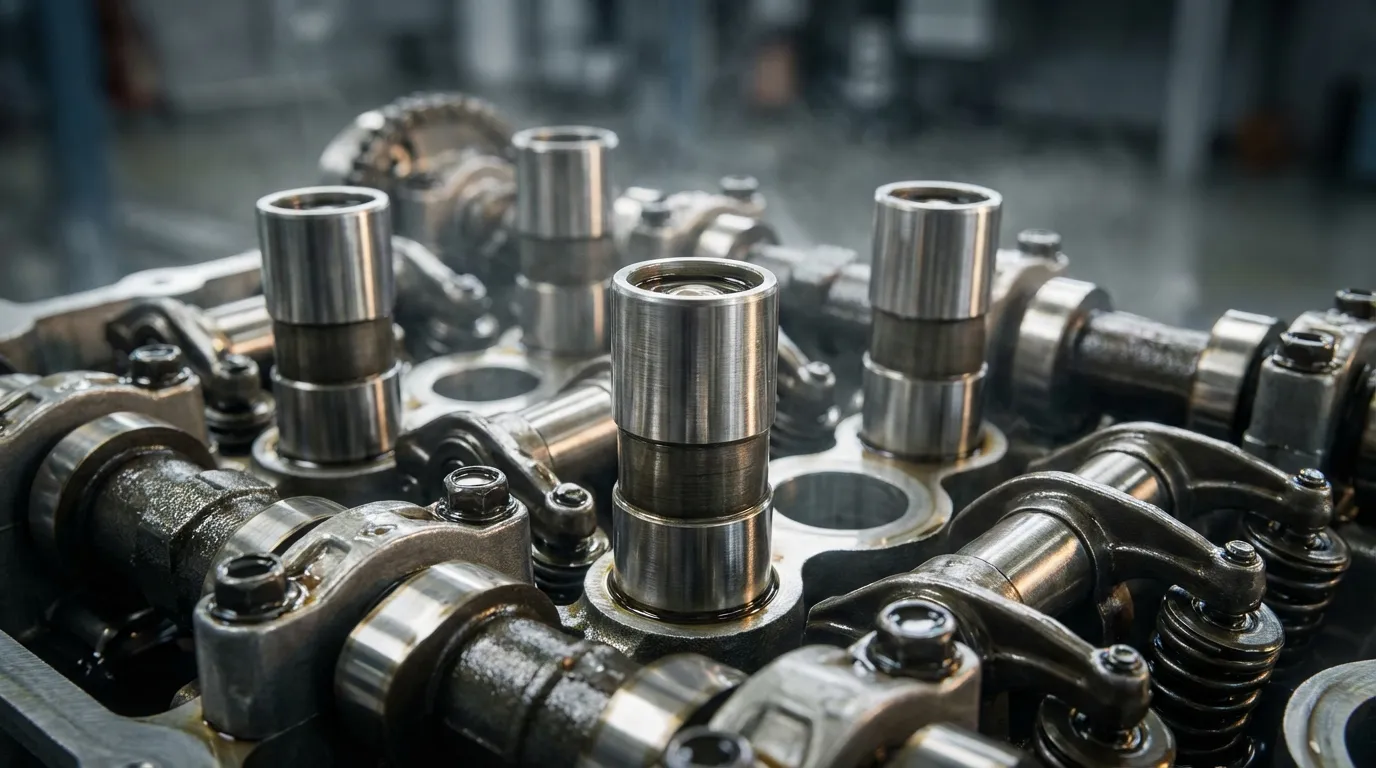
What Are Hydraulic Lifters and Why Do They Exist?
To understand why some engines use hydraulic lifters, we first need to face an inevitable engineering problem: heat and wear change dimensions. When the engine heats up, metal parts expand. Over time, contact and friction also cause wear. The valvetrain (camshaft, lifters, pushrods or rockers, and valves) is particularly sensitive to small variations.
In this scenario, the necessary “clearance” for the system to operate without binding arises. This clearance is known as lash (or *valve clearance*). It needs to be exact:
- Too little clearance: the valve might not seat completely, compromising compression, overheating the assembly, and increasing the risk of damage (especially to the exhaust valve).
- Too much clearance: the valvetrain becomes noisy, the cam “slams” to take up the slack, wear increases, and engine efficiency drops.
In older engines and some high-performance applications, adjustment is made using mechanical (solid) lifters. They are robust and predictable but require periodic adjustment. Hydraulic lifters, on the other hand, were adopted to reduce maintenance and noise because they can automatically compensate for clearance variations using the engine’s own oil pressure.
In other words: the hydraulic lifter is a solution for those who want comfort, silence, and low maintenance for daily use, without relying on constant adjustments.
The hydraulic lifter doesn’t “add horsepower.” It provides something the owner feels every day: a quieter engine, smoother operation, and less need for clearance adjustments.
Speaking of automotive engineering evolution driven by seemingly simple decisions, once you finish this read, consider this one: AUTOMOTIVE ENGINES: The Brutal Truth About the War Between Cast Iron and Aluminum That Changed Your Car.
How a Hydraulic Lifter Works (No Mystery, No Mysticism)
Despite the name, the hydraulic lifter is not a little pump. Think of it as an intelligent, self-adjusting shim that uses pressurized oil to keep the assembly “lash-free” during operation.
The operation, simplified, follows this cycle:
- When the cam lobe is not pushing (on the base circle), the lifter is “at rest.” At this point, oil enters the lifter, filling an internal chamber.
- The lifter has an internal plunger. With oil inside, it positions itself to eliminate clearance in the valvetrain.
- When the cam begins to lift the lifter, a check valve closes the passage, “trapping” the oil inside. The lifter then acts as if it were solid, transmitting movement without “sinking.”
- When the cam passes its peak and returns, pressure drops, the lifter resets, and refills for the next cycle.
The practical result is what matters: the system maintains zero operational lash most of the time, compensating for thermal expansion and progressive wear.
Why the Engine Becomes Quieter with Hydraulic Lifters
The valve “tick-tock” in many engines comes from the repeated impact when clearance is “taken up” abruptly. It’s like slamming a door with play: every cycle becomes a micro-impact. In the valvetrain, this happens thousands of times per minute.
With hydraulic lifters, clearance virtually disappears. So, instead of a sharp impact closing the “gap,” the movement becomes more continuous: less banging, less vibration, less noise. As a bonus, there tends to be less wear on components like rockers, valve tips, and cam surfaces.
But there is a price: this magic depends on the correct oil, adequate oil pressure, and internal cleanliness. When lubrication is unhealthy, the lifter can “bleed down,” and noise reappears.
Speaking of habits that damage your car without the driver realizing it, this article often opens people’s eyes: Maintenance Mistakes That Are Making Your Mechanic Rich and Putting Your Safety at Risk.
Advantages, Disadvantages, and Signs of Trouble (The Guide to Avoiding Misdiagnosis)
The question “why do some engines use hydraulic lifters?” becomes even clearer when we weigh the real-world gains and limitations.
| Aspect | With Hydraulic Lifter | With Mechanical Lifter |
|---|---|---|
| Noise | Quieter for most of the service life | More noise, especially if clearance is off |
| Maintenance | Eliminates frequent clearance adjustments | Requires periodic adjustment (depending on design) |
| Oil Sensitivity | High: wrong/dirty oil reduces lifter performance | Lower: still needs lubrication but is less “temperamental” |
| Extreme High RPM Use | Can suffer from “pump-up”/collapse under specific conditions | Preferred in many racing applications for predictability |
Engine Ticking: When the Hydraulic Lifter Becomes Suspicious
If the engine with hydraulic lifters starts ticking, it doesn’t automatically mean “the engine is seizing.” Usually, the noise is a symptom of temporary loss of hydraulic adjustment or internal lifter failure.
The most common signs include:
- Noise on cold start that disappears in seconds or minutes (oil hasn’t fully pressurized, or the lifter drained while parked).
- Persistent noise even with a warm engine (may indicate a collapsed lifter, contaminated oil, low pressure, sludge, or wear).
- Performance issues, rough idle, and loss of power (if the valve isn’t following the cam as it should).
The critical point: hydraulic lifters rely on oil as their “structure.” If the oil is old, has inadequate viscosity, is aerated (foamy), or contains sludge, the lifter may fail to maintain its load. This becomes even more evident in high-mileage engines.
And before rushing to replace expensive parts, it’s worth remembering that there are “basic” causes that seem minor but cause cascading damage. One of them is choosing the wrong maintenance out of misguided economy. A very useful parallel is found here: Stop Coasting Downhill in Neutral: The Economic Lie That Can Destroy Your Car’s Engine.
What Truly Causes a Hydraulic Lifter to Fail
In practice, the most common failures stem from three areas:
- Contamination: Particles and sludge can jam the internal plunger or compromise the check valve.
- Low oil pressure: Worn pump, partially clogged pickup screen, low fluid level, excessive internal engine clearances, or oil that is too thin for the condition.
- Air in the oil: Foaming reduces the lifter’s “hydraulic rigidity.” Instead of a solid oil fill, you get compressibility, and the lifter loses its ability to maintain zero lash.
Important: Hydraulic lifters can be durable for a long time when the engine receives the basics done correctly: the right oil, a decent filter, and a coherent change interval. The problem is that many people only think about the oil when it’s already noisy.
If you want to elevate your preventive maintenance game (and avoid a small detail turning into a big bill), combine this topic with another point that causes mistaken diagnoses (and invisible costs): FAKE IGNITION COILS: The Invisible Hit That Can Melt Your Engine and Drain Your Wallet.
Why Not Every Engine Uses Hydraulic Lifters (And Why It’s Not “Outdated”)
If hydraulic lifters are so good, why are there still engines with mechanical lifters? Because engineering is about trade-offs. In competition applications and specific designs, mechanical lifters may be preferred for:
- Absolute clearance control to tune behavior at high RPMs.
- More predictable response under extreme conditions, without depending on the oil’s “state” at that moment.
- Less internal complexity of the part (although the system as a whole varies by design).
For street cars, however, the public’s priority is different: silence, comfort, low maintenance, and reliability with minimal intervention. Add to this emissions standards and refinement demands (NVH: Noise, Vibration, and Harshness), and it’s easy to see why most modern engines have adopted hydraulic solutions for valve actuation (whether in lifters or hydraulic adjusters integrated into rocker arms in OHC architectures).
In summary, the question “why do some engines use hydraulic lifters?” has an answer the driver feels at the wheel: the engine becomes more civilized. And when something goes wrong, the noise is an alert to check what truly supports this technology: lubrication.
If you want to elevate your preventive maintenance game (and avoid a small detail turning into a large bill), also read this: WHY OVERINFLATING YOUR TIRE TO THE PSI IS A TERRIBLE IDEA: THE TRUTH THAT CAN SAVE YOUR CAR.