
Google reveals the Suncatcher Project, an orbital data center. Why does AI need the vacuum of space to survive? Find out the solution.
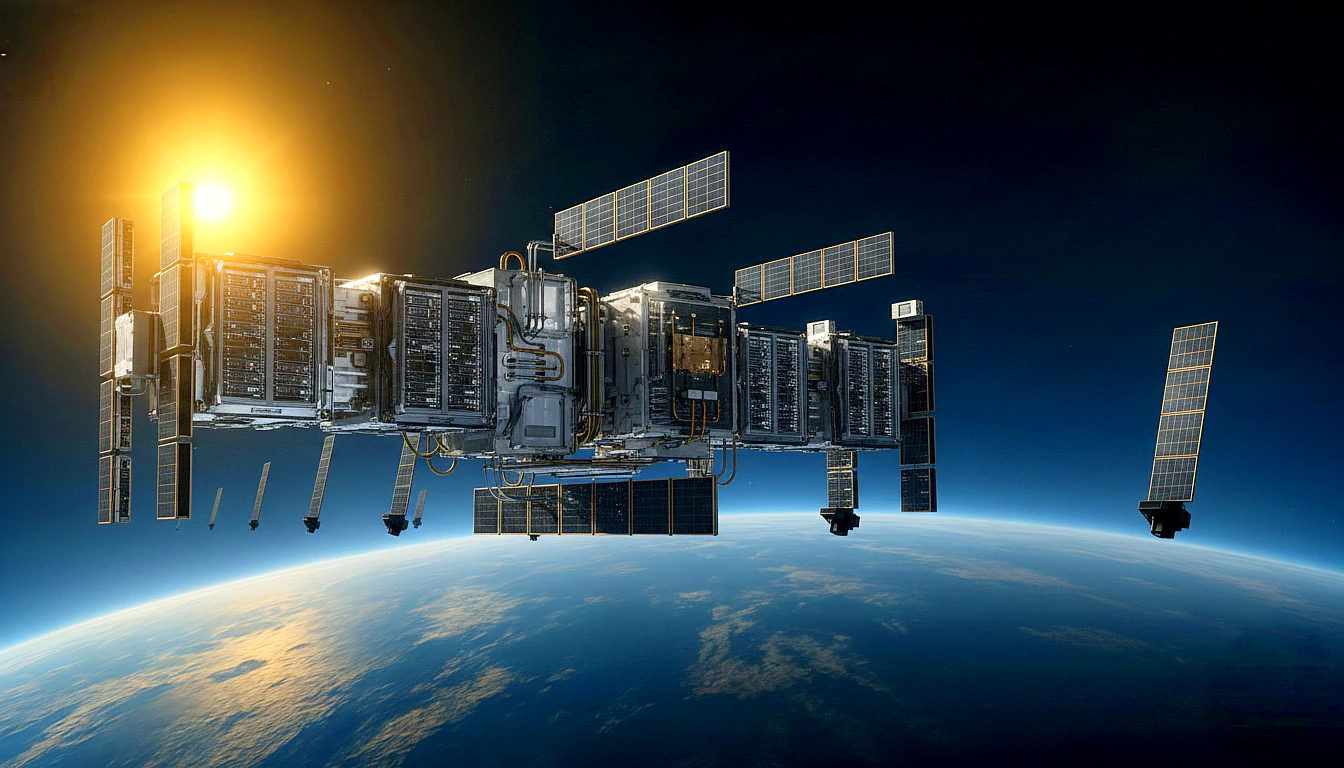
The future of Artificial Intelligence (AI) is no longer on Earth. Alphabet, Google’s parent company, has revealed the daring Suncatcher Project, an ambitious “moonshot” initiative that plans to shift the massive processing power of AI to Earth’s orbit, transforming the vacuum of space into a sustainable supercomputer.
In recent years, AI has transformed industries, but at a colossal environmental cost. The Suncatcher Project is Google’s radical response to this crisis, aiming to finally bypass the insatiable resource consumption of terrestrial data centers.
The Earthly Problem: Why is AI Killing the Planet?
The exponential expansion of generative AI and machine learning (ML) demands an unprecedented hardware infrastructure. The cost is not only financial but ecological.
Insatiable Resource Consumption
The problem with traditional data centers lies in two critical bottlenecks: energy and cooling. It is estimated that AI technology alone will consume up to 12% of national energy in developed countries by 2030. This massive consumption has chain effects:
- Carbon Emissions: Dependence on the traditional power grid drastically increases greenhouse gas emissions.
- Water Scarcity: To keep Tensor Processing Units (TPUs) running at safe temperatures, intensive cooling is necessary. This devours vast quantities of water, depleting vital resources in regions where data centers are located.
It is this brutal need for electricity and water that led Alphabet to think outside the box, or rather, outside the atmosphere. Moving large-scale computing off-planet is the only way to ensure AI’s long-term viability without compromising power grid stability and potable water supplies.
In this era of technological escalation, Google is Activating a “Billion-Dollar Engine” Against NVIDIA, but the competition for AI dominance is not limited to developing more powerful chips; it now extends to the final frontier: space.
The Suncatcher Architecture: How 81 Satellites Become a Supercomputer
The Suncatcher Project is not about launching a single heavy monolith but rather a distributed network. The proposed technical solution involves a cohesive constellation of 81 smaller satellites, all equipped with Google’s powerful TPUs. These satellites fly together, communicating via high-speed lasers, effectively acting as a single unified data center.
| Component | Space Advantage (GEO Optimized) |
|---|---|
| Cooling | The vacuum of space acts as a universal heat dissipator, completely eliminating the need for water. |
| Power Supply | Uses a “dawn-dusk” orbit to ensure perpetual sunlight exposure. |
| Solar Efficiency | Captures solar energy eight times more efficiently than on Earth’s surface. |
Eight Times More Efficient Solar Energy
The choice of the “dawn-dusk” orbit is the project’s masterstroke. In this specific orbital trajectory, satellites remain constantly bathed in sunlight, maximizing energy production 24 hours a day. This starkly contrasts with terrestrial facilities, which depend on the unstable electrical grid and are limited by day/night cycles. This energy efficiency not only reduces environmental impact but could theoretically make AI computing cheaper in the long run. It’s an infrastructure revolution, much like Toyota Revolutionizes: Solid-State Battery in 2027 Ensures 1,000 km Range and Fast Charging in the automotive sector.
Challenges, Competition, and the 2027 Space Race
Despite the conceptual brilliance, the Suncatcher Project faces monumental technological and regulatory hurdles. Integrating 81 satellites to operate flawlessly as a unit, maintaining ultra-fast optical communication, is an engineering challenge that CEO Sundar Pichai hopes to mitigate with in-orbit test satellites by 2027.
Competition is also heating up. NVIDIA, the chip giant, has already signaled interest in orbital computing, though their announced plans do not reach the complexity of a full data center like Suncatcher. Dominance in AI is the new frontier, and companies are fighting to secure their future infrastructure.
The Risk of Space Debris
The most serious challenge, however, is the systemic risk that such satellite constellations pose. Low Earth Orbit (LEO) is already congested. Adding 81 new satellites operating in cohesive formation increases the collision risk. A single event could trigger the so-called “Kessler Syndrome,” creating a cascade of debris that could make orbits unusable for decades, affecting communication satellites, GPS, and even climate monitoring. As AI redefines our relationship with work and family, as seen in Black Mirror in Real Life: Toyota Kids Mobi Proves AI Will Replace Parents, the supporting infrastructure must be safe.
Google believes that energy efficiency and the unlimited cooling capacity of space outweigh these risks. If successful, the Suncatcher Project will not only solve the resource crisis of AI but also pave the way for a new era of distributed computing, where solar energy is harnessed with maximum efficiency, far beyond the limits of automotive engineering that sought to optimize consumption with turbo 4-cylinder engines.
The concept of an “orbital supercomputer” is leaving the realm of science fiction and becoming a reality financed by Alphabet. This moonshot is not just about moving servers but about redefining the sustainability of the most powerful technology of our era. If Google manages to overcome the complex engineering challenges and debris risks, we will be looking at the future of global infrastructure.
Such grand technological ambitions show that big corporations are investing in solutions that seem impossible, just as automotive engineering continues to push the limits of performance and efficiency, as demonstrated by the 2026 Porsche 911 Hybrid with 701 Horsepower Humiliates Nürburgring Records.