
A “rotary” engine that doesn’t look like the Wankel, spins its own block like a wheel and even splashes castor oil everywhere. This is the GNOME OMEGA, a 1908 French experiment that became a legend in aviation for being as ingenious as it was inconvenient.
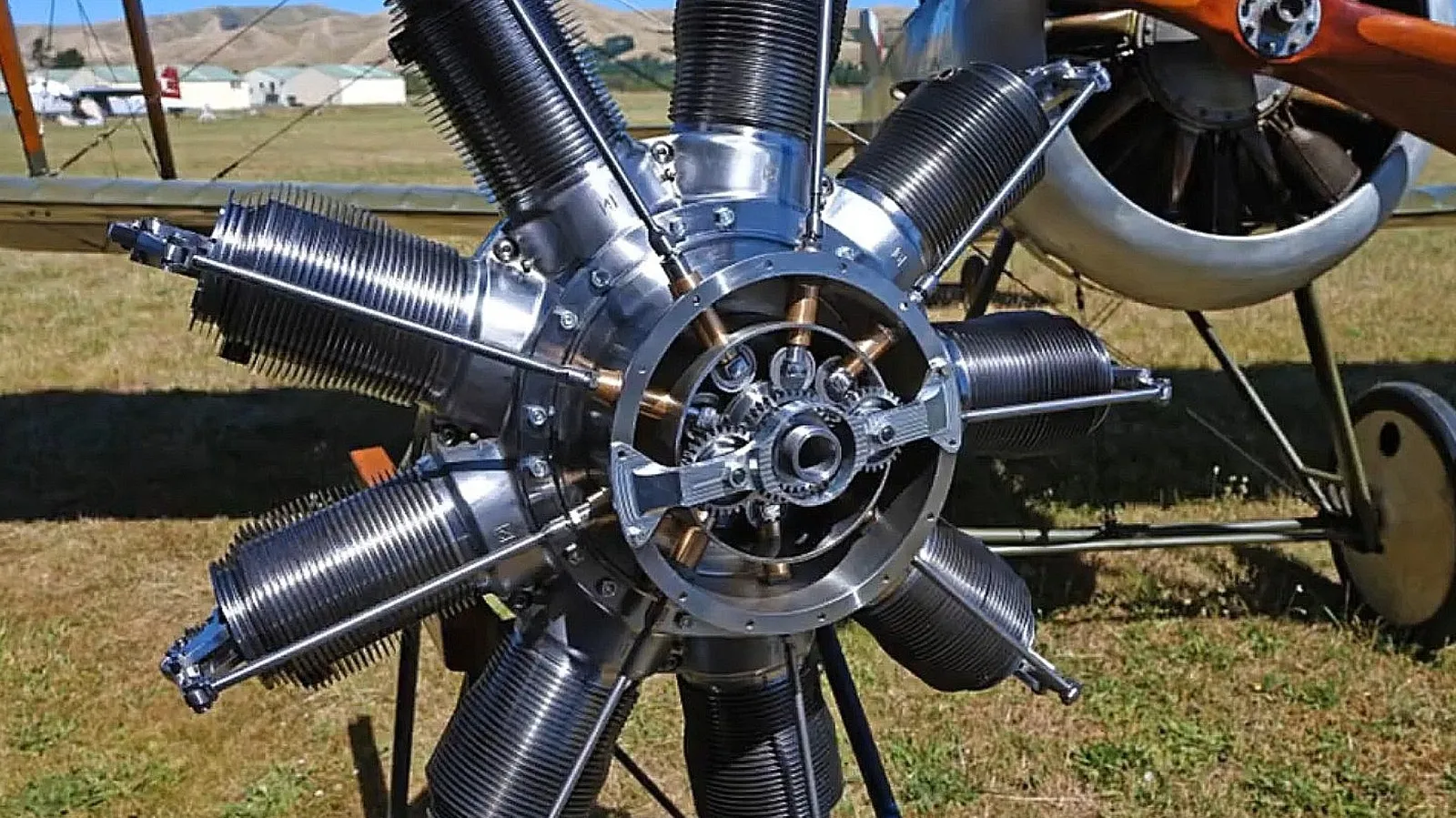
What Was the GNOME OMEGA and Why It Still Seems Like a Forbidden Idea
When talking about a rotary engine, many people immediately think of the concept popularized decades later by the Wankel (that one with the triangular rotor and epitrochoidal housing, famous in Mazda cars). But the GNOME OMEGA is from a different lineage. It is “rotary” for a much more literal reason and, by today’s standards, almost absurd.
Presented in 1908 by the French company Gnome (later linked to the Gnome et Rhône group), the Omega was designed for an era when airplanes were lightweight, cowlings were minimal, and reliability was a daily gamble. Its trump card was delivering power with mechanical simplicity and good cooling without a radiator. The recipe was bold:
- Configuration seven cylinders in a star (radial), air-cooled
- Displacement approximately 8.0 liters (8.01 L in many historical references)
- Typical power about 50 HP at approximately 1,200 rpm in the early versions
- “The trick” instead of the crankshaft rotating and the block staying still, the cylinder and crankcase assembly rotated around a stationary shaft/crankshaft
Visually, it resembles a wheel hub with “thick spokes.” In practice, each cylinder that passes “in front of” the wind receives constant cooling. This made sense in an era when reducing weight and eliminating auxiliary systems was almost as important as generating power.
If you enjoy strange solutions that were “swallowed” by technological advancement, it’s worth following up with another engineering discussion that also divides opinions today, but in the modern automotive world, like in Why 5-Cylinder Engines Are So Rare and how efficiency ended up killing charismatic formats.
How the French Rotary Engine That Rotated Its Own “Block” Worked
The GNOME OMEGA sought to be extremely simple for its time. In terms of fuel supply and control, it was more “mechanical and direct” than many people imagine:
- No conventional carburetor in many historical descriptions of the early model, using mixing solutions compatible with the project’s simplicity
- One valve per cylinder (intake), with unusual cycle management
- Ignition by spark plug, with limited power control
The cycle (simplifying) involved intake and compression with timings “adapted” to the design, followed by ignition just before top dead center and exhaust. The detail that turns this engine into living history is that everything happens while the entire engine is spinning. This brings two immediate consequences:
- Efficient cooling because the cylinders “ventilate” themselves all the time
- Strong gyroscopic effect because there’s a lot of mass spinning fast in front of the plane
This gyroscopic effect altered the sense of control and could “help” to one side and “hinder” to the other in maneuvers. In combat, this wasn’t an academic detail; it was the difference between hitting an alignment or losing valuable seconds.
And speaking of technical differences that change everything in real use, the logic of “the invisible detail becomes the big dilemma” also appears in current projects, like in the GMC TERRAIN 2027, where the practical experience weighs as much as the numbers.
The Castor Oil That Leaked Without Mercy And The Reason GNOME Left the Scene
The most “viral” aspect of the GNOME OMEGA isn’t just it spinning like a mechanical fan. It’s the fact that it became known for spreading castor oil everywhere.
The engine used a total loss lubrication system. Instead of the oil circulating and returning to the crankcase to be reused, a significant portion was ejected during operation. As the assembly spun, centrifugal force helped fling oil droplets and mist. In airplanes with open cockpits, the result was inevitable: the pilot and fuselage got a “bath” of lubricant.
It wasn’t just dirt. Castor oil was widely used because it was a lubricant that worked relatively well with the conditions and fuels of the period and burned more cleanly in certain scenarios. But it has a well-known physiological detail: it can act as a laxative. On long flights, with mist and residues in the air, some pilots reported unglamorous side effects. The myth gained traction precisely because it makes sense from a chemical standpoint and the type of exposure in open cockpits.
Add to that important limitations:
- Primitive power control in various versions, often based on cutting/turning on ignition, which is terrible for piloting finesse
- Scalability limit greatly increasing size and power made the rotating mass and stresses even more problematic
- Advancement of other architectures conventional radial and inline engines evolved quickly and delivered more power with better control
Not by chance, the GNOME equipped various airplanes from the World War I period, and historical estimates often cite tens of thousands of units produced in different variations. But, past its peak, it became a museum piece and an obsession for restorers.
Curiously, the fascination with the “different” didn’t die. The industry keeps playing with limits and out-of-the-standard solutions, but now with materials, electronics, and efficiency goals. If you like that tension between mechanical romanticism and modern performance, compare the radical spirit of the past with current engineering works like the BUGATTI W16 MISTRAL or with the return of the debate on rotaries and brand identity in the MAZDA CX-5 2026.
Today, the GNOME OMEGA survives as a reminder of an era when “simple” could mean “spin everything” and “lubricate” could mean “spread on the pilot”. And that’s exactly why, 118 years later, it still seems stranger than many futuristic prototypes.