
The ultimate battle between Horsepower and Torque. Understand the physics behind towing and why the numbers on the spec sheet can be misleading.
If you’ve ever gotten into a heated discussion about vehicles, you’ve probably heard the old maxim: “Horsepower sells cars, torque wins races.” But when it comes to towing heavy loads, this oversimplification can be dangerous. The truth is that looking at a vehicle’s technical sheet and choosing just one favorite number is like trying to guess the ending of a movie by only watching the trailer. Both power (horsepower) and torque are vital, but they work as two sides of the same mechanical coin, operating in a complex dance that determines whether your vehicle will dominate the road or struggle uphill.
The Invisible “Muscle”: Understanding Torque
To demystify torque, forget complex engines for a moment and think of a stubborn jar of pickles. The brute force you apply to the lid to make it start turning? That’s torque. In engineering terms, it is the force responsible for making an object rotate. In the automotive context, it’s what pushes you back against the seat when the light turns green.
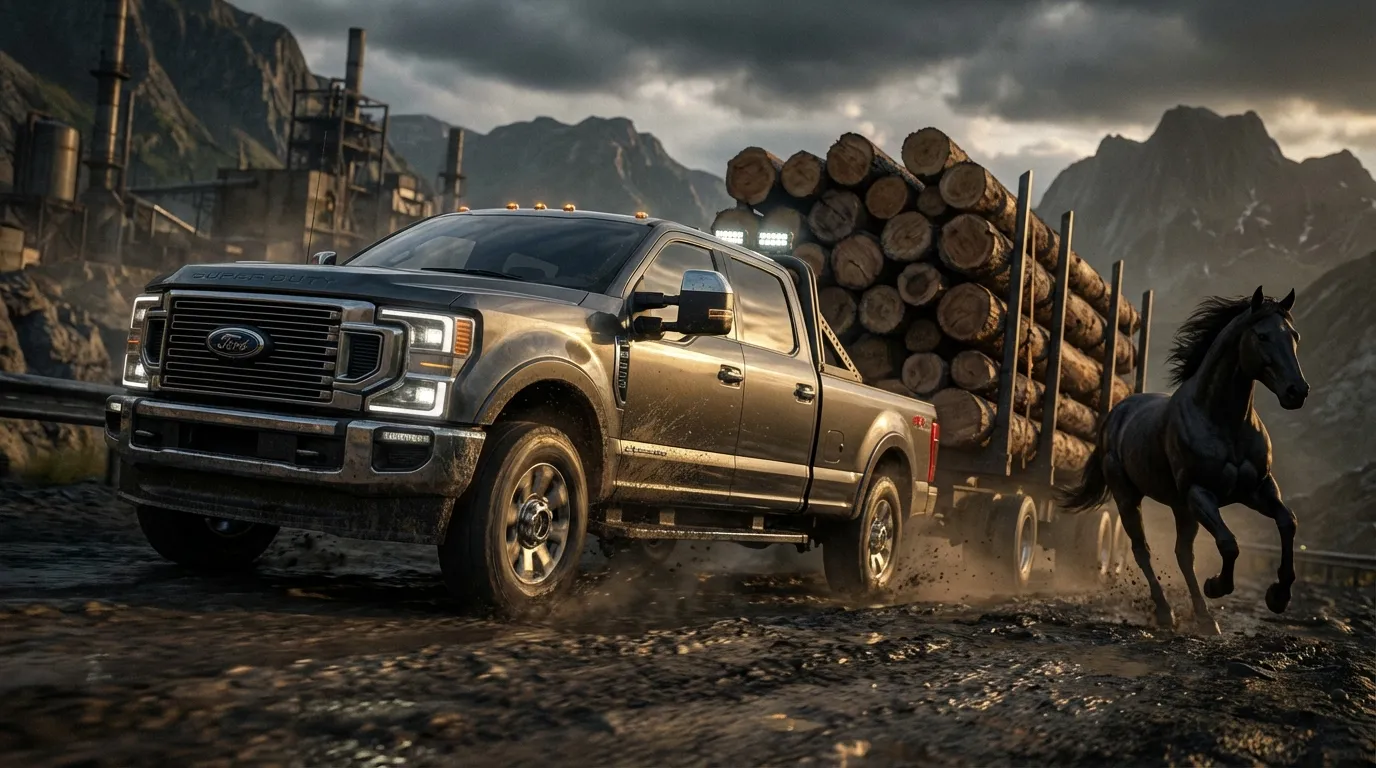
This is where a titanic example comes in: the FORD SUPER DUTY. This engineering beast cannot tow an impressive 40,000 pounds (nearly 18 tons) just because it’s large. It achieves this feat because its engine generates enormous 1,200 lb-ft of torque. This force is crucial at low revolutions per minute (RPM), which is exactly the moment when the wheels need to overcome inertia and start rolling with a heavy load attached behind.
Many drivers focus only on the final power output, but they overlook the internal construction of the engine. The choice of materials, for example, directly influences the engine’s ability to handle these extreme forces without failure. The brutal truth about the war between cast iron and aluminum shows us that block durability is essential when dealing with torques that rival locomotives.
Horsepower: The Speed of Execution
While torque is force, horsepower (measured in HP or kW) is the measure of how fast this force can be applied over time. If torque is the bodybuilder lifting the maximum weight, horsepower is the CrossFit athlete repeatedly lifting that weight at high speed.
Imagine an analog gauge on your vehicle’s dashboard. On the left, we have “Torque”; on the right, “Horsepower.”
- During takeoff: The needle is stuck on the left (Torque). You need force to move the weight.
- During mid-acceleration: The needle starts moving toward the center.
- At highway speeds: The needle is on the right (Horsepower). Here, inertia has been overcome, and the goal is to maintain speed against air resistance.
Many modern luxury SUVs try to balance these two worlds, but some overdo it in the pursuit of marketing power figures, forgetting usability. It’s interesting to see how elite brands handle this, such as in the case of the Lotus Eletre gaining a surprising 952 horsepower gasoline engine, showing that brute power still has its place, even in the electrification era.
The Towing Battle: The Verdict for US Drivers
So, what matters more for towing? The short answer is: Torque, but with an important caveat.
Torque is essential to get the load moving. Without sufficient torque at low RPM, you would have to rev up the engine to the limit just to move the trailer a few inches, burning the clutch or overheating the torque converter. That’s why diesel engines are kings in towing: they deliver mountains of torque almost immediately.
However, once you are on the highway at 65 mph and need to overtake a truck climbing a grade, it’s the horsepower that will ensure you maintain speed. If you have lots of torque but little power, the vehicle will be strong off the line but will “die out” at high speeds.
Manufacturers are constantly adjusting this balance. Recently, we saw interesting updates where small changes lead to big practical gains. Take the case of the Hyundai Santa Fe PHEV 2026, which increased power and gained nearly 70% towing capacity, showing that the proper calibration between the electric motor and the combustion engine can transform a family vehicle into a capable load-hauling machine.
The Myth of Torque Only for Trucks
There’s a common misconception that torque is only for trucks and tractors. That’s incorrect. Torque is the secret behind that “glued to the seat” feeling in sports cars.
Let’s take the extreme example of the Bugatti Veyron. It became famous for its 1,000+ horsepower, which propelled it to 268 mph. But what allowed it to go from 0 to 60 mph in 2.5 seconds wasn’t horsepower, but its massive 1,106 lb-ft of torque. The massive rotational force is what catapults the car before maximum power has a chance to shine.
Today, hybrid supercars are rewriting these rules, using electric motors to fill torque gaps while turbos fill in the rest. The Lamborghini Temerario is living proof of this new era, retiring conventional engines in favor of architectures that deliver instant torque and insane power.
The Electric Revolution and Instant Torque
The rise of Electric Vehicles (EVs) has completely changed the conversation about towing and performance. In an internal combustion engine (ICE), you need to wait for the engine to rev up (increase RPM) to reach the ideal torque range. It’s an upward curve.
In an electric motor, torque is instantaneous. It’s like a light switch: turn it on, and the maximum force is there. This means EVs are, in theory, incredible tow vehicles because they don’t struggle to get the load moving from inertia. The KIA EV6 GT, for example, uses its 568 lb-ft of torque to outperform supercars in acceleration, at a fraction of the cost.
Comparison Table: Combustion vs. Electric in Towing
| Feature | Internal Combustion Engine (Diesel/Gasoline) | Electric Motor (EV) |
|---|---|---|
| Torque Delivery | Progressive (needs RPM) | Immediate (0 RPM) |
| Power Range | Limited at certain RPMs | Linear and constant |
| Disadvantage in Towing | Transmission (gear shifting under load) | Drastic autonomy loss |
However, to keep any engine—whether focused on torque or power—operating at its peak, maintenance is unavoidable. Small details, like the spark quality in the combustion chamber, can steal precious torque numbers. The technology behind spark plugs has evolved significantly, and knowing how to choose between ruthenium vs. iridium might be the secret to saving your engine and ensuring all the force promised on the sheet makes it to the wheels.
“Torque is what you feel. Power is what you read in the magazine.” – Old automotive saying.
When choosing your next towing vehicle, don’t just look at the highest number. Look at the torque graph. If the peak torque occurs early (at low RPM) and lasts a long time, you’ve found your ideal work partner. If torque only appears when the engine screams at 6,000 RPM, get ready for a stressful towing experience.
And remember: power and torque work together. An engine with lots of torque and little power is a tractor; lots of power and little torque is a 600cc sport bike. The secret to perfect towing is in the balance between a bear’s strength and a marathon runner’s endurance.