
Have you ever stopped to wonder why some engines deliver more power with the same displacement? Or why certain turbocharged cars require higher octane gasoline? The answer may lie in a part that weighs less than a smartphone, but that dictates the rules for the entire operation of your engine: the shape of the piston.
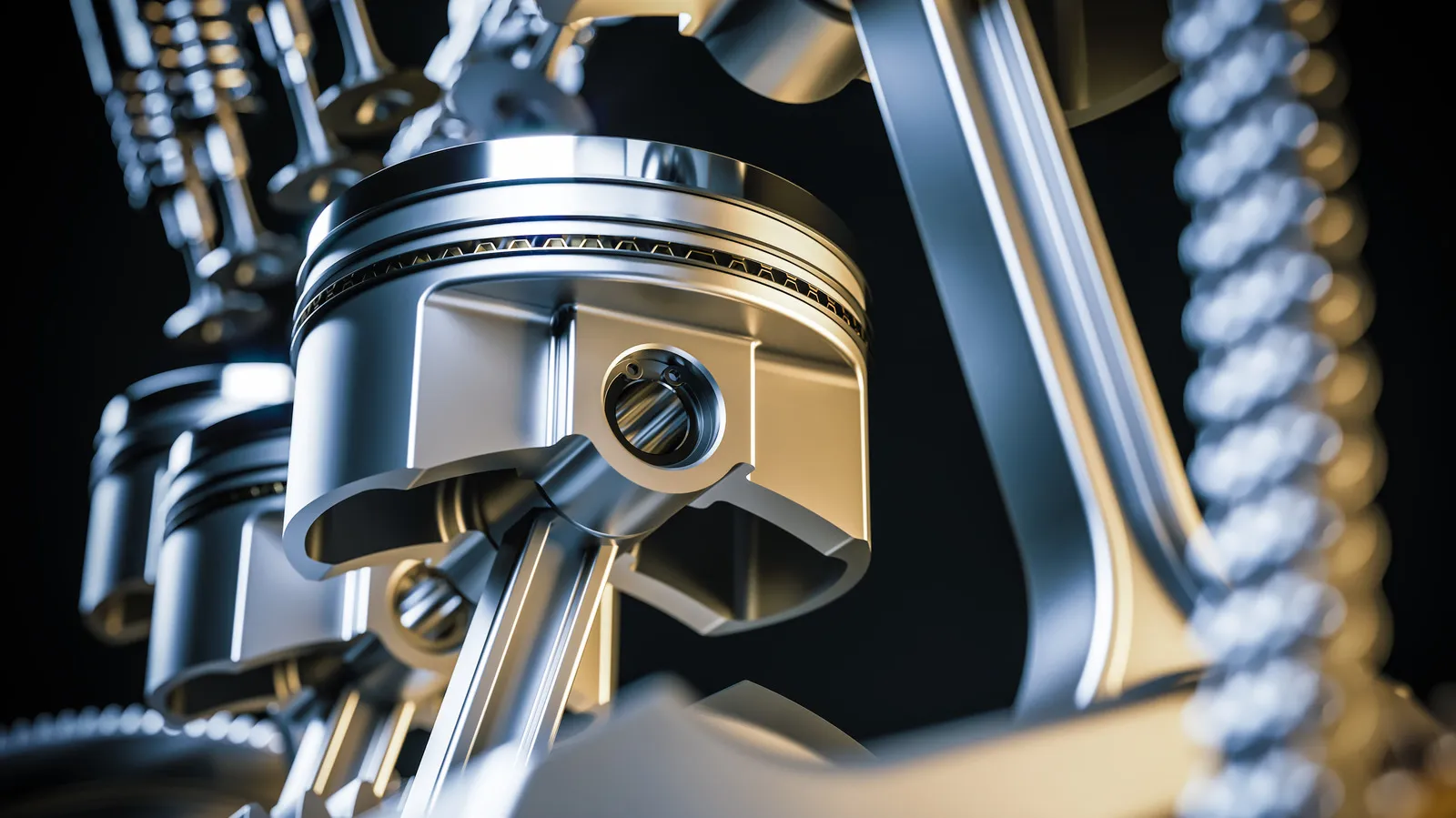
The Heart of Combustion Hidden in the Piston Crown
The piston crown — that top surface you rarely see — is a thermodynamic battleground. It’s where millimeter decisions take place that separate efficient engines from true heat-wasting bombs.
Three shapes dominate automotive engineering: the domed piston, the flat-top, and the dished. Each carries trade-offs that directly affect the flame propagation, the compression ratio, the quench (flame extinction at the edges), and even the formation of turbulence in the intake air.
The paradox? There is no “best shape.” There is only the right shape for the application. And choosing wrong can mean the difference between an engine that lasts half its intended life and another that passes 500,000 kilometers without a head gasket failure.
Domed: Raw Power That Commands Respect
Domed pistons, like those found in the legendary Dodge Hemi, are double-edged swords. Their pronounced curvature increases the compression ratio by reducing the volume of the combustion chamber — mathematically, more compression means more useful work extracted from the same air-fuel mixture.
But here lies the danger. A very pronounced dome interferes with the flame front, creating slow and incomplete combustion. The result? Detonation, power loss, and, in extreme cases, holes in the crown of the piston itself.
“Engine builders prefer wide and less pointed domes instead of tall domes. The balance is always delicate.”
The technical challenge multiplies when you need to create valve reliefs. Small combustion chambers + high dome + large valves = geometry bordering on impossible. That’s why high performance engines with domed pistons often require strict maintenance and high-octane fuel.
Dished: The Forced Engine’s Refuge
When volumetric efficiency (VE) exceeds 100% — read: turbo and supercharger — the rules of the game change completely. Here, the concave piston reigns supreme.
The cavity on top of the piston deliberately lowers the compression ratio, creating a safety margin against pre-ignition and detonation. In forced induction engines, where air is already compressed, a high static compression ratio would be mechanical suicide.
| Feature | Dished Piston | Ideal For |
|---|---|---|
| Compression | Reduced | Turbo/Supercharger |
| Thermal safety | High | High sustained loads |
| Design complexity | Low | Mass production |
| Combustion | Moderate | Street engines |
Interestingly, engineers consider the concave piston the least challenging to design. Its generous geometry naturally allows valve clearance, even with more conservative camshafts.
Flat-Top: The Perfect Compromise That Conquered the 21st Century
When there is a consensus in modern engineering, it is called the flat piston — or more precisely, almost flat. The smooth top surface offers the best combustion quality available, with uniform flame fronts and controlled extinction at the edges.
The silent revolution happened when three technologies converged:
- Modern cylinder heads with combustion chambers optimized by CFD (computational fluid dynamics)
- Commercially accessible high-octane fuels
- Direct injection that precisely controls fuel distribution
With these tools, engineers have managed to extract adequate compression without sacrificing combustion quality. The result is that today, even standard turbocharged engines use essentially flat pistons, with only micro-curvatures to accommodate valves.
The collateral benefit? Reduced manufacturing cost. Flat pistons are simpler to forge or cast, easier to balance in batches, and offer predictable mass distribution for high revs.
Next time you hear someone talking about “building the engine,” ask which piston shape is being considered. The answer will reveal whether the design prioritizes maximum track power, durability for the street, or that rare balance that makes an entry-level sports car deliver 90% of the thrill with 50% fewer headaches. Shape, after all, has never been so linked to function — and mechanical survival.