
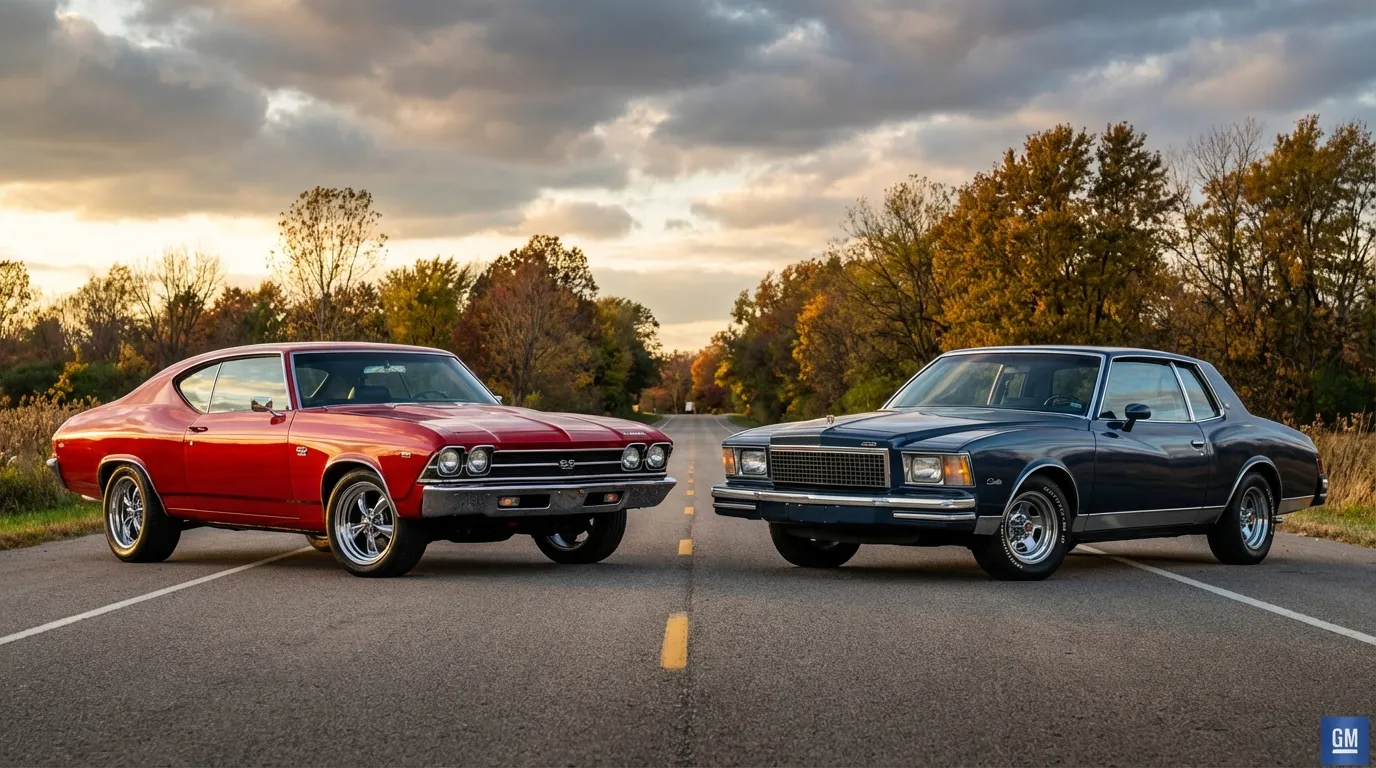
A-Body Vs. G-Body: What Is A Platform And Why Did GM Confuse The Names
In the automotive world, platform is the car’s “skeleton”: structural architecture, suspension positioning, chassis solutions, and the base that defines proportions (like wheelbase), mechanical packaging (engine/transmission), and often, the car’s “feel” on the road. GM used letters to name vehicle families for decades, and this creates a classic problem: the same letters started to mean different things as generations changed.
In other words: A-Body and G-Body are not just “two types of old GM cars.” They are timelines with changes in concept—and at a crucial point, GM literally transferred the A-Body name to cars with a different architecture, making the old platform “become” the G-Body.
To avoid getting lost, remember this simple rule:
- Classic A-Body is associated with the peak of GM’s RWD midsize cars and the muscle cars derived from that base.
- G-Body is born as a variation of the A-Body in some larger coupes and later becomes the “new name” for the old RWD A-Body when A-Body starts designating FWD cars in the 1980s.
If you enjoy engineering and maintenance, it’s worth drawing a parallel: platform isn’t just “history,” it’s also why certain parts fit (or don’t). And speaking of fit and decisions that affect your wallet, there’s one topic that always resurfaces strongly in Brazil: Brand Name Engine Oil vs. Store Brand Oil: Does It Really Make A Difference In Brazil? The logic is similar: behind the name, there is specification and correct application.
Timeline: How The A-Body Changed Segments And Even Drivetrain
The term A-Body appears in GM’s history in the first half of the 20th century, but what interests most enthusiasts is the moment it became synonymous with midsize and, mainly, high performance across different brands within the group.
“Classic” A-Body (Midsize, RWD): The Cradle Of Several Icons
When GM consolidated a family of rear-wheel-drive midsize cars, the A-Body became the perfect ground for “clones with personality”: each division (Chevrolet, Pontiac, Oldsmobile, Buick) created its own style, engines, and packages, but shared the base. This allowed GM to scale production and reduce costs while delivering cars with distinct “faces.”
The result was an era where the public saw the birth (and shine) of models that defined the muscle car imagination:
- Chevrolet Chevelle (and sporty variations)
- Pontiac with performance packages that became benchmarks
- Oldsmobile with its tradition of torque and presence
- Buick with versions that balanced luxury and power
In practice, when someone talks about the “original A-Body,” they are usually referring to this period when the platform was RWD, with classic proportions (long hood, set-back cabin), and a huge variety of V8 engines.
The Turning Point: A-Body Becomes FWD (1980s Onward)
Now comes the part that confuses even collectors: in the 1980s, GM repurposed the name A-Body for a new family of Front-Wheel-Drive (FWD) cars. This changes the entire conversation, because the architecture (engine-transmission positioning, subframe, weight distribution, dynamics) becomes entirely different.
So, from this point on, you might hear two people saying “A-Body” and referring to completely different cars—one thinking of the classic RWD midsize and the other thinking of FWD sedans from the 80s and 90s.
If you enjoy understanding how engineering choices change a car’s behavior, a complementary reading that makes sense is The Difference Between Single-Clutch and Dual-Clutch Transmissions: Understand What Changes For Your Car and Your Wallet: it’s not nostalgia, it’s architecture deciding everything.
G-Body History: From “Stretched A-Body” To The Most Popular Platform of the 1980s
The G-Body is a special case because it has “two lives” in automotive culture:
- First, as a variation very close to the A-Body of its time, especially in personal luxury coupes and models with a more American “grand tourer” proposal.
- Later, as the official name GM gave to the RWD base that continued in production when the “A-Body name” was reallocated to the new FWDs.
Initial G-Body: Technical Similarity And A Proportion Trick
In the initial phase, the main difference usually found in discussions is the wheelbase. In simple terms, some G-Bodies were born as “close relatives” of the A-Body, but with a slightly longer wheelbase to accommodate a longer design and a more “executive/sporty” presence.
This detail might seem small, but it makes a difference in three things:
- Aesthetics: longer profile, different overhangs, and a more “cruiser” stance.
- Stability: generally, more wheelbase aids in straight-line stability.
- Packaging: space and proportion for interior/trunk according to the design.
The “Real” G-Body For Most: The Popular RWD of the 1980s
When the A-Body became FWD, GM needed a name for the old RWD base that still made commercial sense. Then the term G-Body came to designate a family of cars that became a phenomenon, especially for three reasons:
- Variety of brands and body styles: sedans, coupes, and even car-like utility vehicles.
- Maintenance and parts: high production usually means more availability and more knowledge in the market.
- Prep culture: rear-wheel drive, engine bay space, and mechanical compatibility fuel projects.
This is where the names that dominated streets, drag strips, and garages in the US come in. And this is also why, when someone says “G-Body,” they are usually thinking of this generation: a set of RWD midsize cars with wide production and enormous cultural presence.
By the way, if you appreciate the “popular, easy to maintain, and can handle a beating” logic, you’ll like another topic that seems simple but changes everything in safety and handling: What Are Tire Sipes and How Do They Affect Braking on Wet and Snowy Roads? On platforms like A-Body and G-Body, where many people mess with wheels/tires, this is gold.
Practical Differences (No Myth): How To Identify A-Body And G-Body And What It Means Today
If your question is “okay, but in the real world, how do I tell them apart?”, the most honest answer is: by the combination of year, model, and architecture. The name alone is not enough, because GM recycled designations.
Quick Identification Checklist
- Look at the car’s year: it’s the strongest filter. Classic A-Body and ’80s G-Body live in different historical windows.
- Check the drivetrain: when A-Body switches to FWD, you are in another “era” of the name.
- Compare proportions: some G-Bodies emerge as “larger coupes” derived from bases close to the A-Body, often with a different wheelbase.
- Confirm via VIN/decoding and catalogs: for serious restoration, this avoids buying the wrong part.
Objective Table: A-Body Vs. G-Body In One Glance
| Item | A-Body (classic) | G-Body (most known) |
|---|---|---|
| Typical segment | Midsize focusing on variety and performance | Midsize/”mid-level” popular, high volume and various divisions |
| Drivetrain (most remembered phase) | Rear-wheel drive (RWD) | Rear-wheel drive (RWD) |
| Point of confusion | Name reapplied to front-wheel-drive cars (FWD) in the 80s | Name comes to designate the old RWD base after the A-Body changed meaning |
| What changes for the owner today | Restoration/performance: variations by brand and year | Abundant parts and knowledge; swap and tuning culture |
Why This Difference Matters In 2026 (And Beyond)
Even if you don’t have a classic in your garage, understanding A-Body vs. G-Body matters for a current reason: automakers still run on platforms. What has changed is marketing: today the public talks about “architecture,” “modular base,” “global platform.” But the logic is the same: reduce costs, speed up launches, and standardize components.
Want to see how the “tradition vs. modernity” debate appears at another extreme of the market? The premium industry also struggles with architecture and interface choices. A delightful example is the return of physical controls in modern sports cars, as you see in Ferrari Amalfi 2027: The New V8 Coupe Redefining Gran Turismo With Fluidity and Physical Controls. It seems like a detail, but it’s product philosophy, just like a platform always has been.
Common Mistakes When Buying An “A-Body” Or “G-Body” Today
- Buying by nickname: an ad saying “A-Body” guarantees nothing without the year/model.
- Ignoring the drivetrain change: A-Body can be RWD or FWD depending on the phase.
- Assuming full interchangeability: even on similar platforms, mounts, subframes, suspension, and brakes vary by year and division.
- Underestimating aging maintenance: rubbers, bushings, lines, and wiring harnesses age. (And some shops thrive on this; if you want to avoid modern traps too, read about Maintenance Mistakes That Are Making Your Mechanic Rich (And Putting Your Safety At Risk).)
The Summary That Ends Discussions at Car Meets
The A-Body was “redefined” over time: from the classic RWD base linked to the peak of midsize and muscle cars, to the name of an FWD family in the 80s. The G-Body starts as a close variation and later becomes the name of the RWD base that continued after the A-Body changed meaning.
If you memorize this, you will not only understand the difference between GM’s A-Body and G-Body but also start seeing the entire industry with new eyes: names change, but platform strategy remains the invisible engine behind almost every car that hits the road.